
Today's UK Horse Racing Results — All Courses, Every Race
 Available in US
Every race. Every course. Results in seconds.
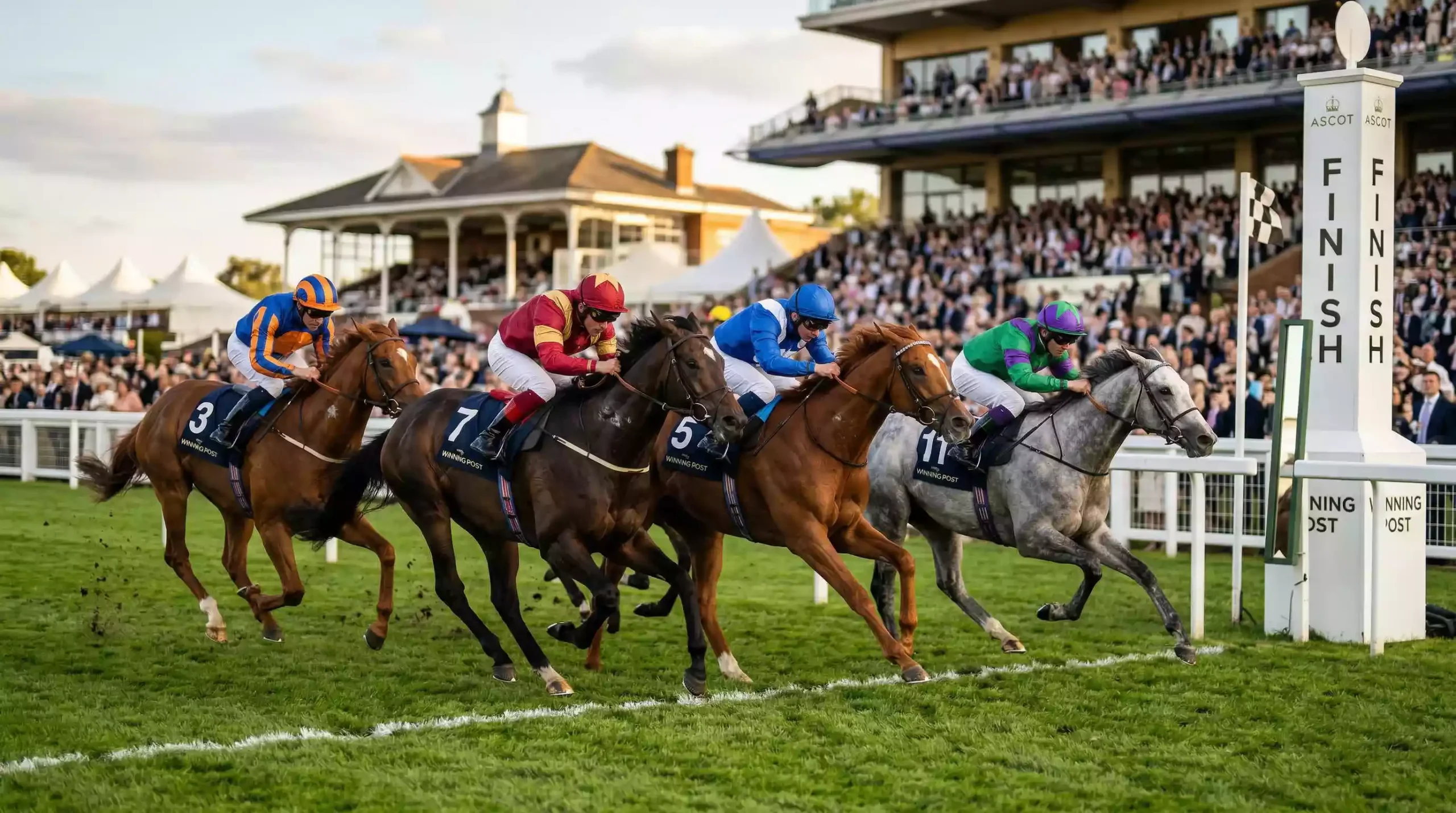
What 59 Racecourses and £766 Million in Bets Produce Every Day
- Britain runs roughly 1,460 fixture days per year across 59 licensed courses — averaging four meetings daily, each generating six to eight individual race results.
- Every result line carries a Starting Price (the industry's default settlement benchmark), winning distances, and in-running comments that together form the basis of form study and bet settlement.
- Results are provisional until "weighed in" is announced; stewards' enquiries can and do change finishing orders, with the BHA panel reviewing at least five camera angles per incident.
- Remote betting on horse racing generated £766.7 million in gross gambling yield in 2024/25, but average turnover per race continues to fall — down 5.6% year-on-year — with spending increasingly concentrated on Premier fixtures.
- Field sizes are shrinking (Flat 8.90, Jumps 7.84 in 2025), driven by a declining horse population of 21,728 in training, making each result marginally less competitive than a year ago.
How Today's Results Are Compiled Across UK Courses
Britain's 59 licensed racecourses are spread from Newton Abbot in Devon to Musselburgh on the Firth of Forth. In 2025, the British Horseracing Authority scheduled 1,460 fixture days — eight fewer than 2024, but still averaging roughly four meetings every single day of the year. Not all of those happen simultaneously, of course. Winter midweeks might see a single all-weather card at Wolverhampton, while a peak Saturday in June can feature half a dozen meetings running in parallel across turf and synthetic surfaces.
The Daily Racing Programme
A typical meeting comprises six to eight races, with the first off around 1:00 PM and the last seldom later than 5:30 PM on turf, though all-weather evening fixtures at venues like Chelmsford City can push final races past 9:00 PM. Each race on the programme has its own conditions — class, distance, ground, age restrictions — and each generates an individual result. Multiply that across the day's meetings and you begin to see why fast, accurate aggregation matters.
Approximately 35% of all races run in Britain are Jump contests — hurdles and steeplechases — while the remaining 65% are Flat, including all-weather fixtures that keep the calendar alive through winter. That ratio shifts with the seasons. Right now, in early spring 2026, Jump racing dominates the schedule, with the Cheltenham Festival just behind us and the Grand National meeting at Aintree approaching in April. By late May, the Flat turf season will be in full swing, and the balance tips sharply the other way.
Why timing matters for results: When multiple meetings run simultaneously, races can clash — meaning two or more go off at the same time, splitting TV coverage and complicating bet tracking. The BHA's protected Saturday window initiative has reduced Saturday clashing races from 8.3% to 5.8% of all races over the course of 2024. Fewer clashes mean faster, cleaner results delivery for punters following the action across courses.
From Finish Line to Your Screen
The chain from race finish to published result is shorter than most people realise. The judge calls the first three or four past the post within seconds. A provisional result — often labelled "fast result" — appears on data feeds almost immediately: the top finishers, their Starting Prices, and the winning distance. This is the version that lands on bookmakers' screens and triggers initial bet settlements.
The full result takes longer. Horses must return to the unsaddling enclosure, the jockeys weigh in (confirming they carried the correct weight), and the Clerk of the Scales signs off. Only then is the result declared official. If a stewards' enquiry is called, even that timeline extends. We cover the mechanics of enquiries in detail below, but the key point here is that "result" is not a single snapshot — it is a sequence of confirmations, and the version you see depends on when you look.
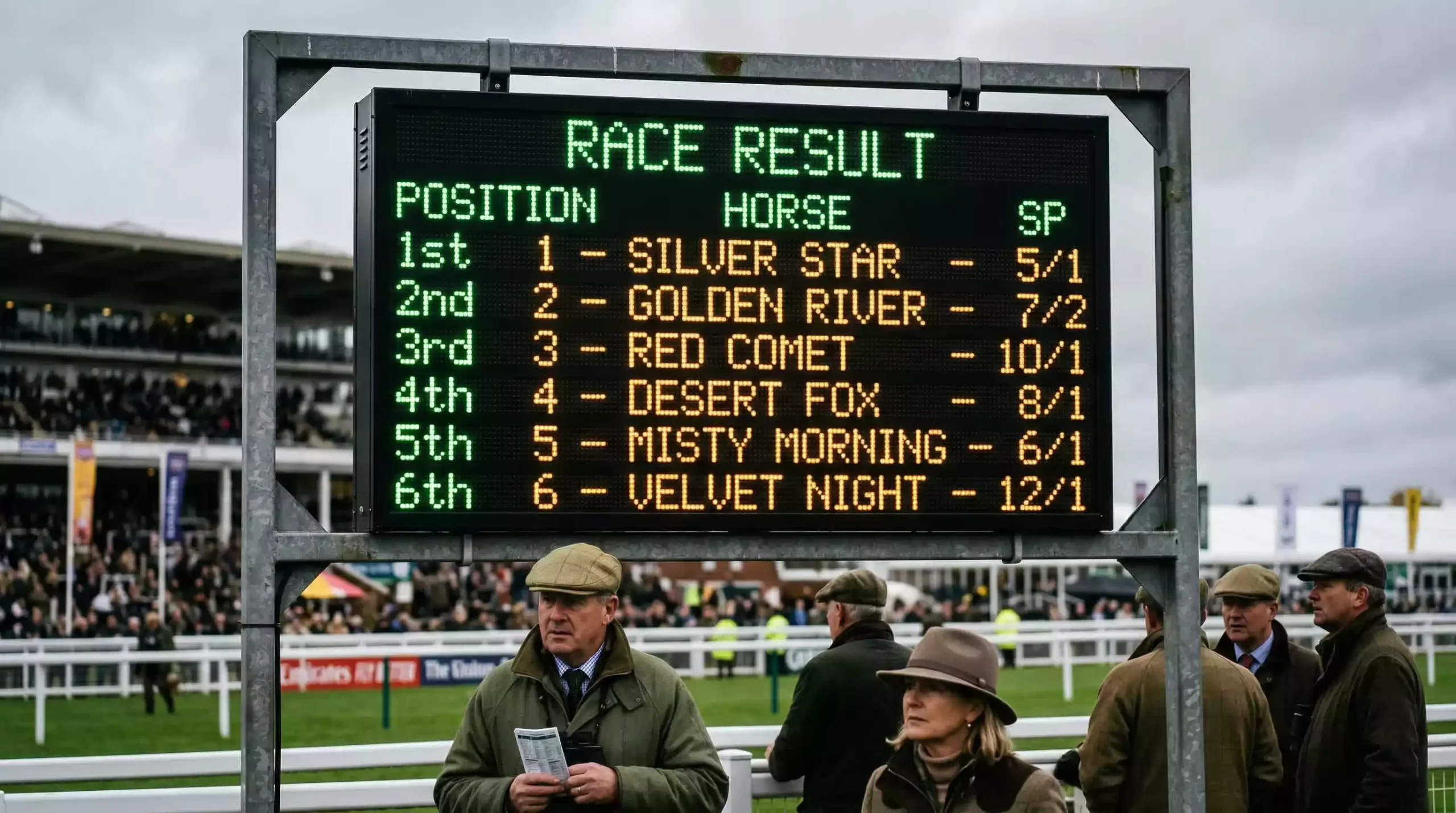
1,460 fixture days scheduled in 2025 across 59 UK racecourses.
"The racing industry has direct revenues in excess of £1.47 billion and makes a total annual contribution to the UK economy of £4.1 billion" — British Horseracing Authority, submission to Gambling Act Review. Those figures sit behind every result you read. Each finishing order is a data point in a vast economic ecosystem — determining prize money distribution, informing breeding decisions, settling millions of pounds in wagers, and feeding the form databases that shape tomorrow's betting markets.
Understanding how results are compiled is the first step toward reading them properly. The next section walks through a single result line, element by element.
Reading UK Horse Racing Results: A Practical Walkthrough
A horse racing result packs a remarkable amount of information into a compact format. At first glance it can look like a wall of numbers, names, and cryptic abbreviations. But once you know what each element does, every result line becomes a story — of pace, tactics, conditions, and margins. Let us walk through the anatomy of a typical UK result.
Finishing Position and Horse Name
The most basic element: where the horse finished. Positions are listed sequentially — 1st, 2nd, 3rd, 4th, and so on, down through the entire field. In a race with twelve runners, every horse that completes the course receives a position. Those that do not finish are listed separately with abbreviations (PU, F, UR — more on these in the glossary section below). The horse's name appears alongside its position, followed by its age and the weight it carried.
Jockey and Trainer
Every result lists the jockey who rode the horse and the trainer responsible for its preparation. This matters far more than casual fans realise. Certain jockey-trainer combinations have significantly higher strike rates at specific courses or on particular ground. When you see a name like Oisin Murphy or William Buick next to a winner, the result tells you something not just about the horse, but about the human decisions behind its performance.
Starting Price
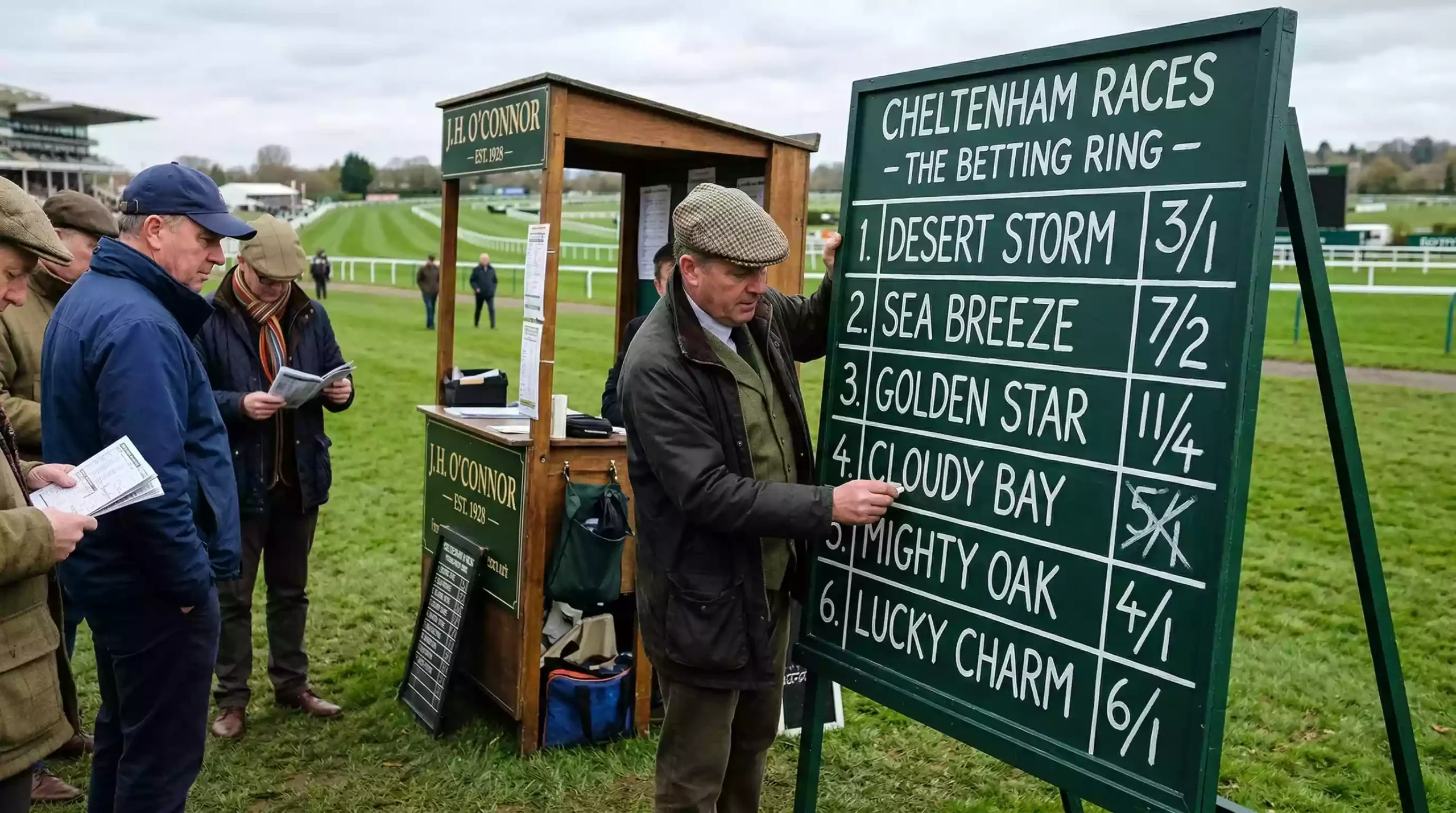
What is SP? The Starting Price is the odds at which a horse begins the race, determined by the on-course bookmaking market at the moment the starter lets the field go. SP serves as the industry's default settlement price. If you placed a bet at "SP" rather than taking a fixed price, this is what determines your payout. It is also the benchmark that Best Odds Guaranteed promotions measure against.
SP appears as fractional odds in UK results — 5/1, 11/4, 8/13, and so on. A horse listed at 5/1 returned five pounds profit for every pound staked. The favourite in the result typically carries the lowest SP (e.g., 6/4 or evens), while outsiders might be 33/1 or longer. SP does not always match the price you saw on a betting exchange or in early-morning markets. It is a snapshot of on-course opinion at the exact moment of the off, and it can diverge sharply from prices available elsewhere.
Winning Distances
How distances work: The gap between finishing horses is measured in a scale of units. A "length" is approximately 2.4 metres (roughly the length of a horse's body from nose to tail). Smaller increments include: neck (about a quarter of a length), head (shorter still), short head (a fraction of a head), and nose (the smallest margin visible to the naked eye). A dead heat means the judge cannot separate two horses — they share the position.
Distances appear between each pair of finishers: "1st [3 lengths] 2nd [nk] 3rd [1¼] 4th." Reading them tells you the competitive shape of the race. A winner pulling away by five lengths suggests dominance. A nose verdict implies the race could have gone either way with a stride more or less. Form students use distances to estimate what a horse might have achieved under different circumstances — a concept sometimes called "collateral form."
In-Running Comments
Full results — as opposed to the quick "fast result" — include brief race-reader comments for each horse. These describe how the horse ran: "led," "tracked leader," "headway 2 furlongs out," "weakened final furlong," "pulled up before 3 out." In-running comments are generated by official race-readers positioned at the course and are a vital tool for form analysis. A horse that "travelled strongly but was short of room on the rail" might be a better prospect next time than its finishing position suggests.
Putting It All Together
Consider a typical result line: 1st — Harbour Winds (5, 9-2) J: R. Moore, T: W. Haggas, SP 7/2, won by 2½ lengths. This tells you the horse is five years old, carried 9 stone 2 pounds, was ridden by R. Moore and trained by W. Haggas, started at 7/2 (a joint or close favourite), and won by a comfortable margin. The distance of two and a half lengths indicates clear superiority, but not a procession — the second horse was in the contest until late.
Each of these data points becomes more meaningful with practice. SP reveals market confidence. Distances quantify margins. In-running comments explain the journey. Together they form the raw material of form study — and the basis for your next bet.
Essential Abbreviations in Results
British racing results are littered with abbreviations, most of which date back decades but have never been formally standardised for a general audience. If you have ever stared at a result showing "PU" in the position column and wondered whether the horse was disqualified, injured, or simply had a bad day, this section is for you. The abbreviations fall into three broad categories.
Did Not Finish
| Abbreviation | Meaning | What It Tells You |
|---|---|---|
| PU | Pulled Up | The jockey deliberately stopped the horse during the race, usually because it was struggling, not travelling, or in the case of Jump racing, becoming a danger to itself. A PU is the most common non-completion code. |
| F | Fell | The horse fell at a fence or hurdle. This only appears in Jump racing results. In Flat racing, falls at the start are exceptionally rare and are noted differently. |
| UR | Unseated Rider | The jockey was dislodged. The horse typically continues running loose, but the result counts as a non-completion. |
| BD | Brought Down | The horse fell or was brought to a stop by the fall of another horse. Not the fault of horse or jockey — an important distinction for form study. |
| RO | Ran Out | The horse left the track, usually at a bend or before a fence. Can indicate inexperience or a strong aversion to the obstacle. |
| SU | Slipped Up | The horse slipped and fell on the Flat — rare, and typically related to ground conditions rather than obstacles. |
| CO | Carried Out | Similar to BD: the horse was forced off course by another runner's interference. |
Disqualifications and Amendments
| Abbreviation | Meaning | What It Tells You |
|---|---|---|
| DSQ | Disqualified | The horse finished but was subsequently removed from the placings, usually after a stewards' enquiry found interference or a rule breach. Your bet settles on the amended result. |
| VOI | Void | The race was declared void — all bets are returned. This is extremely rare and usually involves a starting fault or an abandoned course. |
Other Codes
| Abbreviation | Meaning | What It Tells You |
|---|---|---|
| RR | Refused to Race | The horse was in the stalls or at the start but refused to participate. Treated as a non-runner for betting purposes in some cases, depending on timing. |
| LFT | Left at Start | The horse was left behind when the stalls opened, often due to being fractious or rearing. Not a withdrawal — the horse was under starter's orders. |
| NR | Non-Runner | The horse was declared to run but was withdrawn before the race started. NRs are removed from the result entirely; bets are voided, subject to Rule 4 deductions where applicable. |
Knowing these codes changes how you read form. A horse listed as "BD" in its last run did not fail — it was a victim of circumstance. A "PU" next to a usually consistent performer might signal a physical issue worth monitoring. And "DSQ" in a previous result means the original form line was rewritten — the horse you are assessing may have actually finished ahead of where its final position suggests.
When Results Change: Stewards' Enquiries
You have backed the winner. The horse crossed the line first, the SP was generous, and your accumulator is alive. Then the dreaded announcement: "Stewards' enquiry." In that moment, the result you saw becomes provisional, and the next fifteen minutes will determine whether you are celebrating or tearing up your slip. Understanding this process is not optional for anyone who bets on horse racing in Britain — it is self-defence.
What Triggers an Enquiry
A stewards' enquiry is initiated by the racecourse stewards (not by jockeys or trainers — that is an "objection," a separate mechanism). The panel typically comprises three stewards, one of whom is a BHA-appointed stipendiary steward with professional expertise. Enquiries are most commonly triggered by three scenarios: interference during the race (one horse impeding another's path), careless or dangerous riding, or a horse not appearing to run on its merits.
Interference is the most frequent cause. If two horses bump approaching the final furlong and one loses ground as a result, the stewards will want to know whether the interference was sufficient to affect the finishing order. This is not always obvious to the naked eye — which is exactly why technology plays a central role.
Inside the Stewards' Room
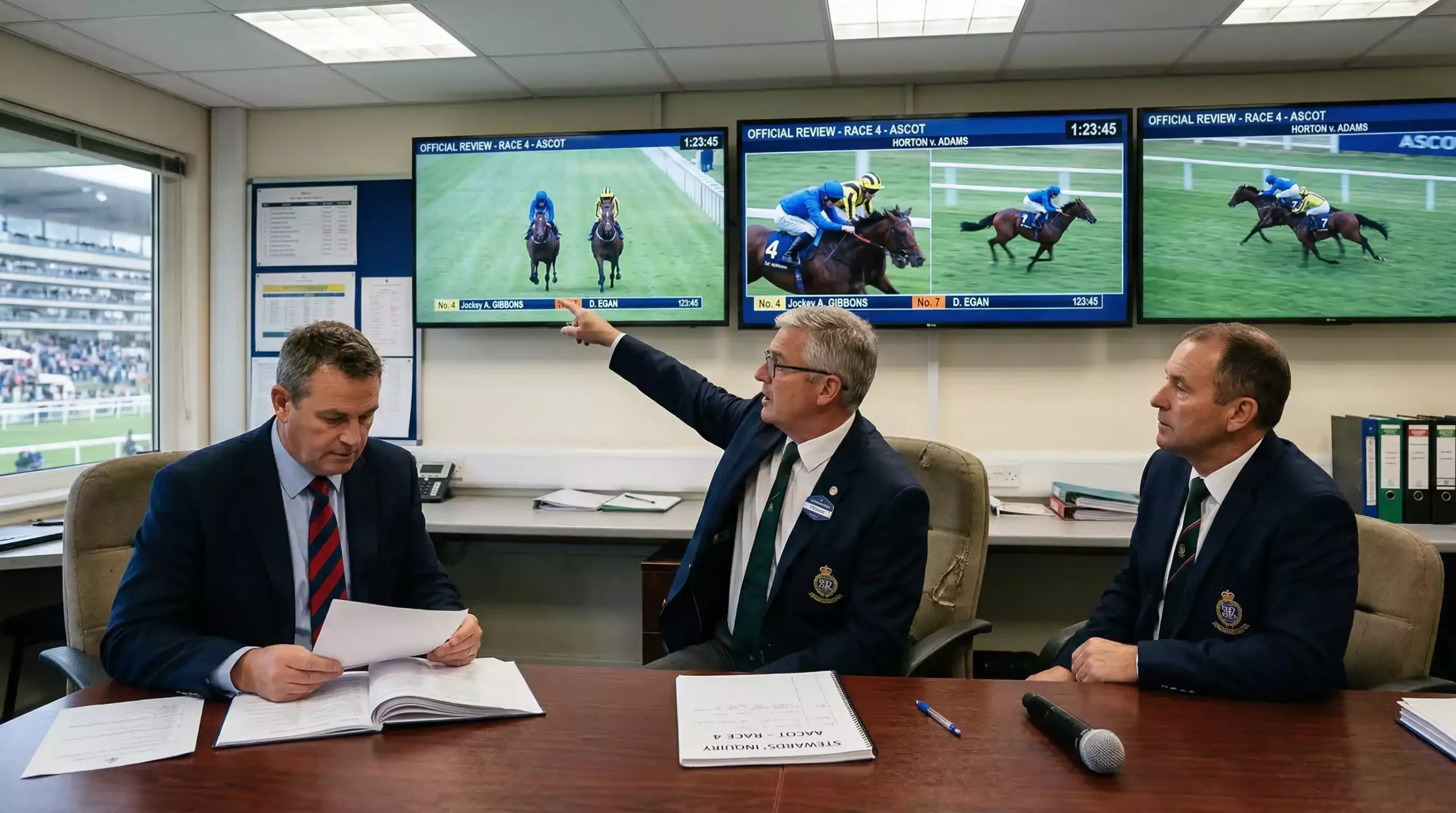
The BHA's own description of the process makes the rigour clear: a stewards' enquiry is held at the racecourse on race day after any given race, and the panel has access to at least five camera angles of the contest. Those angles cover the head-on view, side-on, a close-up side-on, and two remote cameras — one in the back straight and one providing a rear view up the home straight. The stewards review the footage frame by frame, then call in the jockeys involved to give their accounts. Trainers may also be interviewed.
Results may change. Until the "weighed in" signal is given and the result is confirmed as official, any finishing order is provisional. If a stewards' enquiry is announced, bookmakers suspend settlements on that race. Do not assume your bet has won — or lost — until the enquiry is concluded.
The BHA's stewards' enquiry FAQ confirms that the panel is advised by the Stipendiary Steward, who presents the case and questions the jockey and trainer. The panel currently has access to at least five camera angles, upgraded from the four referenced in earlier BHA publications. The typical resolution time is around fifteen minutes, though complex cases — particularly those involving multiple horses or allegations of non-trier status — can take longer.
Possible Outcomes
The outcome spectrum ranges from "no action" to full disqualification. The stewards might find that interference occurred but did not affect the result — in which case the finishing order stands, though the jockey may still face a suspension or fine. Alternatively, they can demote the offending horse by one or more places, or disqualify it entirely. In the most clear-cut cases, the horse that crossed the line first is placed last of the finishers, and the entire result is reshuffled.
Historical examples illustrate how dramatic these shifts can be. The 2015 St Leger at Doncaster saw Simple Verse demoted after a stewards' enquiry, only for the decision to be overturned on appeal — restoring the original result and causing chaos for anyone who had already torn up their betting slips.
Appeals and the Disciplinary Panel
Racecourse stewards' decisions are not always final. Since the BHA restructured its Disciplinary Panel in 2017, connections have had the right to appeal demotion and disqualification decisions to an independent panel. Notably, the majority of these appeals have been successful, with suspensions and disqualifications overturned more often than they have been upheld. This is worth knowing: if a stewards' enquiry demotes your horse, the story might not be over.
The appeals process typically takes days rather than minutes, however, and your bet will be settled on the racecourse result in the interim. If an appeal succeeds and the original result is reinstated, bookmakers must re-settle — though policies vary, and keeping your receipt is always wise.
What This Means for Your Bet
Most licensed bookmakers settle on the official result — that is, the result after any stewards' enquiry is resolved. If the horse you backed was first past the post but gets demoted, your bet loses. Some bookmakers offer "first past the post" payouts as a promotional concession, paying both the original and amended winner. This is not a legal requirement — it is marketing. Check your operator's terms before assuming you are covered.
How Results Settle Your Bets
Every horse racing result is, at its core, a settlement instruction. The finishing order determines who won, the Starting Price determines the payout, and the official confirmation — the "weighed in" signal — triggers the entire betting industry's settlement machinery. In a market where the Gambling Commission reports gross gambling yield of £766.7 million on horse racing from remote betting alone in 2024/25, the precision of this process is not trivial.
Starting Price as Settlement Benchmark
If you placed a bet at a fixed price — say 5/1 at 10:30 AM — your payout is locked in regardless of what happens to the odds before the race. But if you took "SP," your payout depends on the Starting Price determined at the moment the race begins. SP is formed by the on-course bookmaking market: the prices offered by bookmakers at the racecourse, aggregated into a single representative figure by an official SP reporter. This mechanism has survived the digital revolution largely unchanged, and it remains the default settlement price across the industry.
For most punters betting online, the fixed-price model dominates. But SP still matters. Best Odds Guaranteed promotions — where a bookmaker promises to pay whichever is higher, your fixed price or SP — rely on the Starting Price as their benchmark. And if a horse drifts from 4/1 in the morning to 8/1 at the off, that SP tells a story about market confidence that fixed-price bettors might have missed.
Weighing In: When the Result Becomes Official
The moment that matters for bet settlement is not the finish line — it is the weighing room. After a race, placed horses' jockeys must weigh in to confirm they carried the declared weight. If a jockey weighs in light (below the declared weight), the horse faces disqualification. Only after the Clerk of the Scales is satisfied and no stewards' enquiry is pending does the announcer confirm "weighed in." At that point, the result is official and bets are settled.
The official result — not "first past the post" — is what settles your bet. Between the finish line and "weighed in," anything can change. Always confirm the final result before counting your winnings.

Each-Way: Where Field Size Shapes Your Payout
Each-way bets are two bets in one: a win bet and a place bet. The place portion pays out at a fraction of the SP if your horse finishes in the top positions. But the definition of "top positions" depends on the number of runners. In a field of five to seven, place terms typically cover the first two. In fields of eight or more, the first three. In handicap races with sixteen or more runners, the first four are paid — at one-quarter of the odds. These terms are not arbitrary; they are linked to the probability distribution created by field size.
This is where the result directly shapes your payout. A horse finishing fourth in a twelve-runner maiden pays nothing on the place portion. The same horse finishing fourth in a twenty-runner handicap earns a place payout. The race conditions, visible in the result header, tell you which terms applied.
Who Bets on Horse Racing
The Gambling Commission's participation survey from April to July 2025 found that 7% of British adults had placed a bet on horse racing in the preceding four weeks — nearly double the 4% recorded earlier in the year. The seasonal spike aligns with the spring racing calendar: Cheltenham in March, the Grand National in April, the beginning of the Flat turf season. Results, in other words, are not consumed by a niche audience. They are seasonal media events with a mass following.
Understanding how results translate to bet settlement is practical knowledge, not academic curiosity. The gap between "my horse won" and "my bet paid out" is filled with SP calculations, place terms, weighing-in procedures, and the occasional stewards' enquiry. Knowing the mechanics means fewer surprises when you check your account.
National Hunt vs Flat: How Results Differ
British racing operates under two codes — Flat and National Hunt — and while the fundamental structure of a result is the same (position, SP, distance, jockey, trainer), the character of those results diverges sharply. Understanding the differences is essential for interpreting form and predicting outcomes.
Obstacles, Distances, and Seasons
Flat racing is exactly what it sounds like: horses run on a level surface without obstacles, over distances ranging from five furlongs (about 1,000 metres) to two miles and five furlongs. Speed is the primary currency. National Hunt racing introduces hurdles (smaller obstacles, around 3.5 feet) and steeplechase fences (larger, around 4.5 feet, often with ditches), over distances starting at two miles and stretching to four miles and four furlongs for marathon chases. Stamina, jumping ability, and courage matter as much as raw pace.
The seasonal split is equally distinct. The Flat turf season runs from April through October, supplemented by year-round all-weather racing at six venues. National Hunt dominates the winter months, with the core season running from October through April. The two codes overlap in spring and autumn, creating transition periods where both are running simultaneously.
Results in Numbers
The BHA's 2025 data reveals measurable differences. Average field size on the Flat stands at 8.90, down from 9.14 in 2024. For Jump racing, the figure is 7.84, a notable decline from 8.49 the previous year. Smaller Jump fields reflect the higher attrition inherent in obstacle racing — you need more horses in training to sustain competitive fields when some percentage will fall, unseat, or be pulled up in every race.
| Metric | Flat Racing | National Hunt |
|---|---|---|
| Typical distances | 5f – 2m5f | 2m – 4m4f |
| Obstacles | None | Hurdles / Fences |
| Core turf season | April – October | October – April |
| Average field size (2025) | 8.90 | 7.84 |
| Common non-completions | Rare (SU, RR) | Frequent (PU, F, UR, BD) |
| Winning margins | Tighter (heads, necks) | Wider (lengths common) |
What This Means for Reading Results
Jump results contain far more non-completion codes. Seeing three or four horses marked PU or F in a twenty-runner novice chase is normal, not alarming. It simply reflects the challenge of navigating obstacles at speed. Flat results, by contrast, almost always see the entire field complete the course, and winning margins tend to be tighter — necks and short heads rather than the comfortable five-length victories more common over fences.
For bettors, the practical implication is twofold. Each-way terms differ because field sizes differ. And form interpretation requires code-specific context: a horse finishing fourth of eight in a competitive Flat handicap may actually have run better than one winning a three-runner National Hunt contest by twelve lengths. Context, as always, is everything.
The Industry Behind Every Result
It is easy to view horse racing results as isolated data — a list of winners and losers, SP odds, finishing distances. But every result sits within an industrial structure worth billions. The economics of British racing determine which races exist, how much prize money is on offer, how large the fields are, and ultimately how competitive — and interesting — the results you consume actually are.
Scale and Economic Footprint
We mentioned the headline figure earlier — an estimated £4.1 billion annual contribution to the UK economy — but what does that actually look like on the ground? The House of Commons Library breaks it down across direct employment, supply chains, and induced spending in surrounding communities. "Across Britain, the industry supports 85,000 jobs — from stable staff, jockeys and farriers to the caterers, cleaners and drivers who keep race days running. The Grand National alone generates £60 million for the Liverpool City Region economy each year" — Brant Dunshea, Chief Executive, British Horseracing Authority, writing in LabourList.
Those are not abstract numbers. They translate directly to the results you see. Higher prize money attracts better horses, larger fields, and more competitive finishes. Lower prize money produces smaller fields, weaker competition, and results that are less useful for form study.
The Levy: How Your Bets Fund the Sport
The mechanism linking betting to racing is the Horserace Betting Levy. Licensed bookmakers pay 10% of their gross gambling yield on British horse racing to the Horserace Betting Levy Board, which then redistributes the money — primarily to prize funds, but also to regulation, integrity, veterinary science, and welfare. In 2024/25, the levy yield reached a record £108.9 million, surpassing the previous high set in 2023/24.
Despite the record levy yield, average betting turnover per race fell by 5.6% in 2025 compared with 2024, by 11.6% over two years. The decline is concentrated at Core fixtures, where turnover per race dropped 8.1%, while Premier fixtures edged up 1.1%. The paradox: bookmakers are generating higher gross margins from lower turnover, so the levy keeps rising even as punters collectively stake less.
Turnover, Participation, and the Bigger Picture
The decline in betting turnover is the dominant trend in the industry's financial data. Average turnover per race at Core fixtures — the everyday race meetings that form the backbone of the fixture list — dropped by 8.1% in 2025 compared with 2024. Only Premier fixtures, the flagship race days at major venues, showed resilience, with turnover per race edging up by 1.1%. The BHA's own analysis notes that betting customers are increasingly concentrating their spending on the biggest events, leaving smaller meetings commercially exposed.
"Racing is facing significant challenges. We will exercise appropriate prudence in expenditure decisions and maintain sufficient reserves as bookmakers' increased profits are being generated from falling turnover" — Anne Lambert CMG, Interim Chair, HBLB, in iGaming Business.
What does any of this mean for the person checking today's horse racing results? Quite a lot, actually. If turnover continues to fall, prize money comes under pressure. If prize money drops, fewer owners invest in horses. If fewer horses are in training — and the 2025 figure of 21,728 already represents a 2.3% decline — field sizes shrink further. Smaller fields mean less competitive racing, less interesting form, and a poorer product for fans and bettors alike. The results you read today are shaped by economic forces that were set in motion years ago.
Frequently Asked Questions
Can horse racing results change after a race finishes?
Yes, and it happens more often than casual fans expect. The most common cause is a stewards' enquiry, where the racecourse panel reviews footage from at least five camera angles to determine whether interference affected the finishing order. If they find it did, horses can be demoted or disqualified entirely, reshuffling the official placings. Results can also change if a jockey fails to weigh in at the correct weight after the race — an automatic disqualification under BHA rules. Until the "weighed in" announcement is made, every result is technically provisional. Bookmakers suspend settlements during an enquiry and pay out only on the final, official result. The safest approach: do not celebrate — or despair — until the result is confirmed.
How do I read UK horse racing results if I am a beginner?
Start with the three most important elements: finishing position, Starting Price, and winning distance. The position tells you where the horse finished. The SP (displayed as fractional odds like 5/1 or 11/4) tells you what the market thought of its chances at the off — and determines payouts for anyone who bet at SP. The winning distance (measured in lengths, necks, heads, or noses) tells you how close the race was. Once you are comfortable with those three, move to the abbreviations. PU means pulled up, F means fell, UR means unseated rider. These codes appear in place of a finishing position and indicate the horse did not complete the course. In-running comments, available in full results, add the narrative: how the horse travelled, where it sat in the field, and why it finished where it did. Most major results pages — Racing Post, At The Races, Timeform — display these elements in a standardised format, so the reading skill transfers across platforms.
How does a stewards' enquiry affect my bet?
A stewards' enquiry pauses bet settlement until a decision is reached. If the result stands unchanged, your bet is settled normally on the official finishing order. If a horse is demoted or disqualified, the amended result is the one that counts. Say you backed the horse that finished first, but a stewards' enquiry demotes it to third for causing interference — your win bet loses. Meanwhile, someone who backed the horse promoted to first now holds a winning ticket. The enquiry process at UK courses typically concludes within fifteen minutes, though complex cases can take longer. During this window, responsible bettors check the official result before assuming the outcome. Since the BHA restructured its Disciplinary Panel in 2017, jockeys and connections have had the right to appeal racecourse decisions. The majority of appeals to the independent panel have been successful, meaning further result changes — albeit days later — are possible. In practice, bookmakers settle on the racecourse decision and re-settle if an appeal reverses it. The BHA publishes punctuality data showing that in Q1 2025, 87.6% of races started on time, which means most results — and therefore most settlements — arrive within a predictable window.
