
How to Read Horse Racing Results — A Beginner’s Complete Guide
 Available in US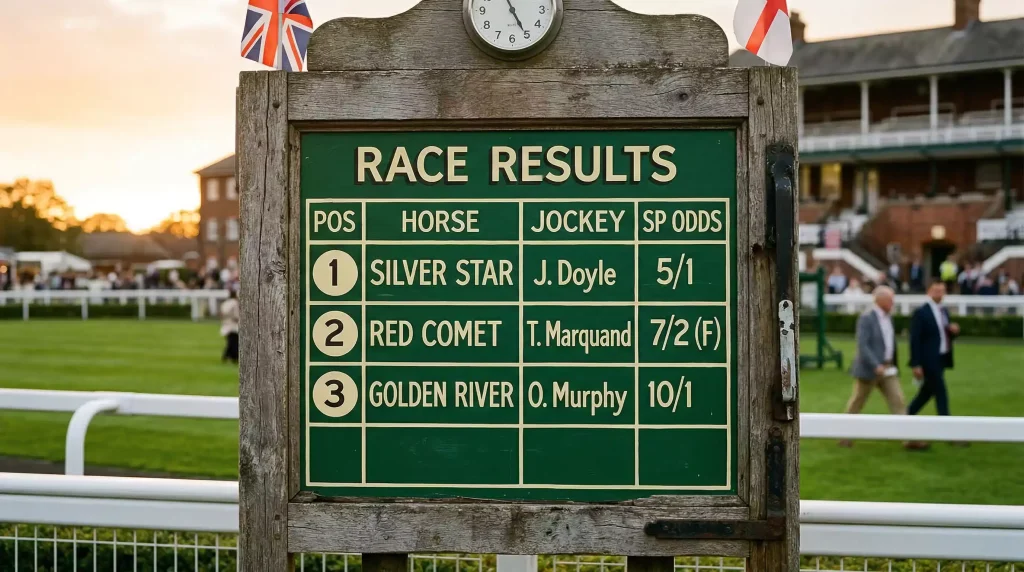
If you have ever glanced at a page of horse racing results and felt like you were reading a foreign language, you are not alone. Those compact lines of numbers, names and abbreviations pack an extraordinary amount of information into a very small space. Every element — from the finishing position to the starting price, from the winning distance to the cryptic form figures — tells part of a story about what happened in a race and, more importantly, what might happen next.
Learning to read horse racing results is one of the most practical skills a racing fan or punter can develop. It is the difference between blindly backing a name you like and making a decision grounded in evidence. The good news is that once you understand the structure, every result card in the country follows the same logic. Whether you are looking at a Class 5 handicap at Wolverhampton on a Tuesday afternoon or the Gold Cup at Cheltenham, the data is presented in the same way.
This guide breaks down each component of a typical UK race result, explains what it means in plain English, and shows you how to use it. No jargon left unexplained, no assumption that you already know your SP from your CSF. By the end, you will be able to pick up any result and extract genuine insight from it — which is exactly what separates casual observers from people who actually understand the sport.
The card that precedes it is explained in reading a racecard.
The Anatomy of a Race Result
Every race result in UK racing follows a standardised format. Once you can identify each column, you can read any result from any of the country’s 59 licensed racecourses. Across roughly 10,000 races held annually — around 60% on the Flat and 35% over jumps, according to data published in the Equine Veterinary Journal — the structure stays remarkably consistent.
Finishing Position
The first thing you see is the most straightforward: where the horse finished. Positions are listed numerically — 1st, 2nd, 3rd and so on, all the way down to the last finisher. If a horse did not complete the race, you will see an abbreviation instead of a number (more on those later). It is worth noting that the position shown in a result is the official position, meaning it accounts for any stewards’ enquiry that may have taken place after the race.
Horse Name, Jockey and Trainer
Next comes the horse’s name, followed by the jockey who rode it and the trainer responsible for preparing it. These three pieces of information might seem like basic identification, but they are the foundation of form study. Knowing that a horse is trained by a handler with a strong record at a particular course, or ridden by a jockey who excels in a certain type of race, adds layers of context that raw finishing positions alone cannot provide.
Age, Weight and Draw
Results also show the horse’s age and the weight it carried. Weight is expressed in stones and pounds — a legacy of British racing tradition that persists even as much of the world has gone metric. In Flat racing, you will also see the draw, which is the stall number the horse started from. The draw matters more than many beginners realise: at certain courses, like Chester or Beverley, a high or low draw can confer a significant advantage depending on the distance and the going.
Starting Price
The SP column shows the starting price — the official odds at which the horse went off. This is the number that matters for settlement if you took SP rather than a fixed price. It is determined by the on-course betting market at the moment the race begins, and it can differ substantially from the price you saw on a betting app hours earlier. SP is so central to UK racing that it gets its own section below.
Winning Distance
Between each finishing position, you will see the distance that separated one horse from the next. These are expressed in lengths, necks, heads, short heads and noses — terms that sound archaic but are precisely defined. A length is roughly 2.4 metres, and the distances shrink from there. If two horses cross the line together, you get a dead heat, which has its own implications for betting.
Taken together, these elements form a single line of data that tells you who won, by how much, at what price, under what conditions, and with whose help. Each race on the card gets its own block, so a six-race meeting produces six of these result blocks, stacked one after another.
Starting Price Decoded
The starting price is arguably the single most important number in any race result, and it is also the one that causes the most confusion. SP is the official price at which a horse starts a race. It is determined by the on-course bookmakers — the people standing in betting rings at the racecourse with their boards and bags — and it reflects the final state of the market at the moment the starter lets the field go.
This matters for a simple reason: if you placed a bet at SP, or if your bookmaker settles at SP for any reason, this is the price that determines your payout. It is also the benchmark used by the industry to calculate betting turnover and, by extension, the Horserace Betting Levy — the mechanism through which bookmakers fund the sport. Remote betting on horse racing generated £766.7 million in gross gaming yield during the financial year ending March 2026, according to the Gambling Commission’s annual industry statistics. Every penny of that activity is ultimately anchored to starting prices.
SP differs from early prices, exchange prices and best odds guaranteed prices. Early prices are offered by bookmakers the morning of a race (or sometimes days before) and can move dramatically as money comes in. Exchange prices are set by punters trading against each other on platforms like Betfair. SP sits apart because it is the only price that comes from the physical racecourse market, and it is independently returned by an official SP reporter. There is no algorithm, no corporate decision — just supply and demand among on-course layers.
For beginners, the practical takeaway is this: if you see a horse won at SP 5/1, it means the on-course market rated it as having roughly a one-in-six chance at the off. If you had backed it at an early price of 8/1, you did well. If you took SP, you got 5/1. The result page shows the SP, not whatever price you personally took, so always compare the two. Over time, the gap between your price and SP is one of the clearest indicators of whether you are finding value or chasing steam.
Winning Distances — What Lengths, Necks and Noses Mean
When you look at a race result, the gaps between horses are measured in a system that has not changed in centuries. Understanding these distances is essential because they tell you not just who won, but how decisively — and that distinction matters enormously for form study.
A length is the standard unit, equivalent to roughly 2.4 metres or about the distance from a horse’s nose to its tail. When a result says the winner beat the second horse by three lengths, it means there was a gap of about seven metres between them at the line. That is a comfortable victory. In contrast, a winning distance of a neck — about a quarter of a length — suggests the two horses were locked together for the final furlong and the winner only pulled clear in the last stride or two.
Below the neck, the units get even finer. A head is shorter than a neck, a short head is shorter still, and a nose is the tightest margin you can get without the result being declared a dead heat. These tiny distances can be the difference between collecting on a winning bet and tearing up your slip, but they also reveal something about the race itself. A nose victory in a Group 1 tells you two horses were perfectly matched. A ten-length rout in a novice hurdle tells you the winner is operating at a completely different level to the rest of the field.
Dead heats deserve a mention because they are rarer than most people think and confusing when they happen. If two horses genuinely cannot be separated on the line, both are declared joint winners. For betting purposes, your stake is halved and paid out at full odds on the half-stake — which means you get back less than a clean win but more than a losing bet. Dead heats also apply to placed positions in each-way betting, which can produce some bewildering settlement calculations.
One detail beginners often miss: the distances shown in results are cumulative between consecutive horses, not cumulative from the winner. So if the result reads “1st — 2 lengths — 2nd — neck — 3rd,” the third horse finished two lengths and a neck behind the winner, not just a neck. Adding up the individual gaps gives you the total distance between any two horses in the field, and that running total is often more revealing than any single margin.
In-Running Comments and Their Value
Beneath or alongside the raw positional data, many results services include in-running comments — brief descriptions of how each horse ran during the race. These are written by race-readers, often working from the press room at the course, and they condense two or three minutes of action into a handful of phrases. They are easy to skim past, but they contain some of the most useful information on the entire result page.
The language is standardised. “Made all” means the horse led from start to finish. “Tracked leader” means it sat just behind the front-runner, presumably waiting for the right moment to challenge. “Headway from two out” tells you the horse was making ground late in the race, which might indicate it was staying on while others were tiring — a valuable clue for future races over the same or longer distances.
Negative comments are equally instructive. “Weakened from two furlongs out” suggests a horse could not sustain its effort, possibly because the trip was too far or the ground did not suit. “Never dangerous” is blunt: the horse was never in contention. “Hampered” or “short of room” indicates the horse suffered interference that may have cost it places, which adds context the finishing position alone does not supply. If a horse finishes sixth but was hampered at a crucial stage, its next run might be worth more attention than a straightforward sixth-place finish would suggest.
Where in-running comments become especially powerful is in combination with other data points. A horse that “travelled well, weakened late” over a mile and a half might thrive at a mile and a quarter. A horse that “stayed on well” to finish fourth after being “outpaced early” could be crying out for a longer trip. These are the kinds of deductions that separate form study from guesswork, and all the information comes free with the result — you just have to read it.
Form Figures at a Glance
If starting prices are the most important number in a single result, form figures are the most important numbers across multiple results. They are the shorthand history of a horse’s recent racing career, compressed into a string of digits and symbols that you will see on racecards and alongside result entries. Once you crack the code, you can assess a horse’s current ability in seconds.
The system is straightforward. Each digit represents a finishing position in a race, with the most recent run on the right. So a form line of 3-1-2 tells you the horse finished third, then won, then finished second — reading left to right is chronologically forward. A “1” is a win, and anything from “2” to “9” is self-explanatory. A “0” means the horse finished outside the first nine, which sounds bad but needs context: in a large-field handicap, finishing tenth out of twenty runners might be a perfectly respectable effort. Context is everything, and this is where field sizes matter. The BHA’s 2026 Racing Report recorded average field sizes of 8.90 on the Flat and 7.84 over jumps, meaning a “0” in a small jump race suggests a worse performance than a “0” in a competitive Flat handicap.
Symbols add another layer. A forward slash (/) indicates a break between seasons — so 1/3 means the horse won in one season and finished third in the next, with a gap between. A dash (-) separates individual runs. The letter P means the horse pulled up (did not finish), F means it fell, U means the jockey was unseated, and R means it refused. Each of these tells you something: a horse with multiple Ps might have a stamina issue or an underlying problem; a horse with an F in its last run might have lost confidence.
The direction of reading trips people up more than anything else. The most recent run is always the rightmost character. So 2-1-4-F-3 means the horse’s last five runs produced, from oldest to newest: second, first, fourth, fell, third. The fall is a concern — but the subsequent third suggests it has regained its footing, literally and figuratively.
What form figures cannot tell you is the quality of the races involved. A horse with a form line of 1-1-1 might have won three weak sellers; another with 3-4-2 might have been running in Group company. This is where the detail behind the digits matters, and why experienced form students always click through to the individual race results rather than taking the shorthand at face value. The figures open the door; the full results tell the story.
Fast Results vs Full Results — When to Use Each
In the age of smartphones and push notifications, most people expect race results instantly. And to be fair, they arrive remarkably quickly. Within a minute or two of the field crossing the line, fast results are published: the first three home, their starting prices, and often the winning distance. If all you need to know is whether your horse won, fast results do the job.
Full results take longer because they wait for the official process to complete. After a race finishes, the horses are unsaddled and the jockeys weigh in — confirming they carried the correct weight during the race. Only after weighing-in is the result declared official. This can take anywhere from five to fifteen minutes, though most are done inside ten. Stewards may also review the race during this window, and if a stewards’ enquiry is called, the delay extends further.
The distinction matters for bettors. Bookmakers settle bets on the official result, not the fast result. If a horse crosses the line first but is subsequently demoted after a stewards’ enquiry, your bet on it loses — unless your bookmaker has a policy of paying out on “first past the post” results, which some do as a goodwill gesture. Relying on fast results alone can therefore be misleading. The extra few minutes of patience can save you from assuming you have won when, technically, the result has not been confirmed.
Punctuality of starts has improved the timeline significantly. According to BHA data, 87.6% of races started within two minutes of their scheduled time in the first quarter of 2026, up from 79.2% in the same period of 2026 and 72.7% in 2023. “From the impact on betting, to the avoidance of clashes and the overall presentation of our racing on television and the experience for racegoers on course, it is vital that races go off on time whenever possible” — Richard Wayman, Director of Racing, British Horseracing Authority. When races start on schedule, the whole downstream chain of results moves faster.
For practical purposes, if you are checking results on a phone during a day at work, fast results are fine for a quick win-or-lose check. If you are doing serious form study — analysing distances, in-running comments, sectional times — you need the full result, and that means waiting for the official version. Bookmarking a service that clearly labels results as “provisional” or “official” saves confusion.
Common Mistakes Beginners Make
Every beginner makes mistakes reading results. That is fine — the system has been evolving for over a century and it was never designed with newcomers in mind. But some errors are so common, and so costly, that they are worth flagging before you start applying what you have learned.
The first and most widespread mistake is confusing SP with the price you see on your betting app in the morning. Early prices are set by bookmakers’ traders and reflect their assessment of the market. SP is determined by actual money wagered on-course. The two can diverge wildly. A horse quoted at 10/1 in the morning might start at 5/1 if a flood of money comes for it — or drift to 20/1 if the money goes elsewhere. If you placed your bet at SP, you get the final number, not the one you saw at breakfast.
The second mistake is ignoring the going. Results do not exist in a vacuum — they happened on a specific ground surface on a specific day. A horse that won by six lengths on soft ground might be ordinary on firm. If you lift the result without checking the conditions it was achieved on, you are missing half the picture. Going information is published alongside results and on racecards; treat it as inseparable from the finishing positions.
Third, beginners frequently overlook stewards’ reports. If a horse finishes fourth and you move on, you might miss that a stewards’ enquiry found it was hampered at the two-furlong pole. That fourth-place finish is worth more than it looks. Stewards’ reports are published on the BHA website and flagged on most results services. Checking them takes thirty seconds and can completely change your reading of a race.
Fourth, there is the “0” trap. As mentioned earlier, a “0” in form figures means the horse finished outside the first nine. Beginners often interpret this as “useless.” It is not. A “0” in a twenty-runner Heritage Handicap at York is a world away from a “0” in a six-runner maiden at Catterick. Always ask: how many ran, and what was the class of the race?
Finally, new punters tend to over-value last-time-out results and under-value longer-term patterns. If a horse won last time, it must be good, right? Not necessarily — it might have won a weak race, or conditions that day suited it perfectly and are unlikely to be replicated. Reading results is about building a picture over time, not reacting to a single data point. The more results you read with attention, the sharper that picture becomes.
Created by the "UK Horse Racing Results" editorial team. The full picture is in today's UK horse racing results.
