
Cheltenham Festival Results — Complete History, Trends and Stats
 Available in US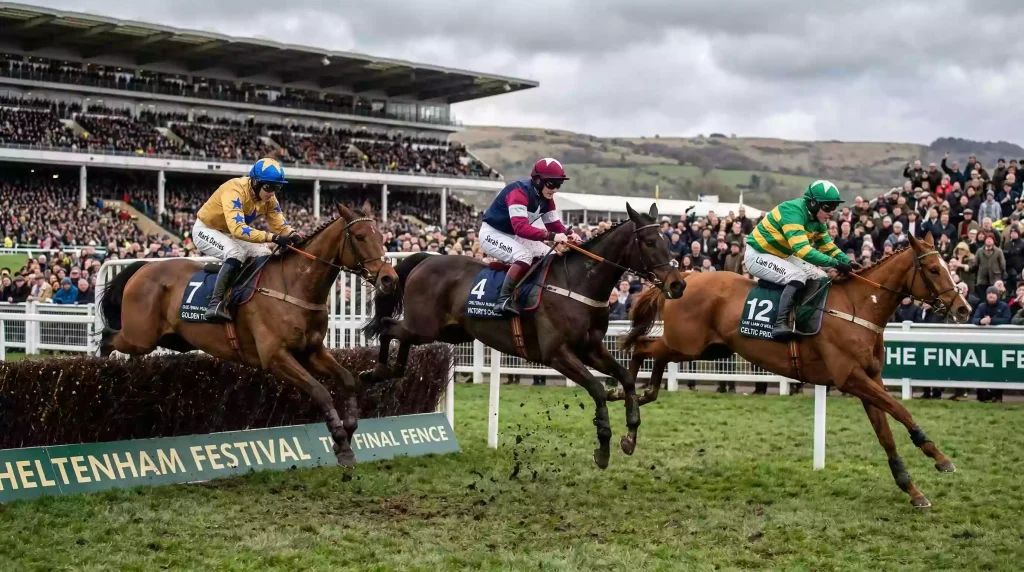
Four days in March. Twenty-eight races. The highest concentration of Grade 1 jump racing anywhere on the planet. The Cheltenham Festival is the event around which the entire National Hunt season orbits, and its results ripple through the sport for months after the final runner crosses the line at Prestbury Park.
For punters, Cheltenham Festival results are not just a record of who won and who lost. They are the data set that shapes ante-post markets for the following season, the benchmark against which every jumps horse in training is measured, and the source of some of the most dramatic stories in racing history. A horse that wins at the Festival is not merely a good horse — it is a horse that has performed on the biggest stage, under the most intense pressure, against the strongest opposition. That distinction matters to trainers, breeders, owners and bettors alike.
This guide covers the full picture: the format of the Festival, the trajectory of its attendance figures, its economic weight, the records that define its feature races, and the way its results feed into the wider betting calendar. Whether you follow Cheltenham closely every year or are trying to understand what the fuss is about, the numbers behind the Festival tell a compelling story — one that is evolving faster than many people realise.
The Festival also occupies a unique position in the cultural calendar. It is one of the few British sporting events that generates mainstream news coverage beyond the sports pages — from the fashion on Ladies’ Day to the economic impact on a Cotswolds market town, from the Irish invasion of fans who travel annually to the welfare debates that inevitably accompany jump racing at its most intense. Understanding the results means understanding all of that context.
The Flat equivalent is Royal Ascot.
Festival Format: Races, Days, and How Results Are Structured
The Cheltenham Festival runs from Tuesday to Friday in the second or third week of March. Each day features seven races, giving twenty-eight in total across the four days. Every one of those races is competitive by definition — the entry requirements and grading system ensure that only horses of genuine quality make the cut, and the prize money reflects that standard.
The programme is built around five headline events, each the pinnacle of its division. The Champion Hurdle opens proceedings on Tuesday, deciding the best two-mile hurdler in Britain and Ireland. The Queen Mother Champion Chase follows on Wednesday, the sprint championship over two miles of fences that tends to produce the most spectacular jumping of the week. Thursday belongs to the Stayers’ Hurdle and the Ryanair Chase — the former a war of attrition over three miles, the latter a relatively modern addition that fills the gap between two-mile speed and Gold Cup stamina. And then Friday: Gold Cup day, the race that defines the Festival and, for many, defines jump racing itself.
The Gold Cup carries a prize fund of £625,000, making it the richest race of the week. But money alone does not explain its status. The Gold Cup is the staying steeplechase championship — three miles and two and a half furlongs up and down Cheltenham’s undulating track, with the famous hill to climb on the final approach to the line. Winning it requires stamina, jumping accuracy, courage and, increasingly, tactical sophistication.
Results at the Festival are structured in the standard UK format: finishing positions, starting prices, winning distances, in-running comments and jockey-trainer details. What sets Festival results apart is the depth of the data that surrounds them. Every result is immediately contextualised by the racing media — sectional times are analysed, running styles are debated, and the implications for future races are mapped out within hours. A horse that finishes third in the Champion Hurdle does not simply have a “third” on its record; it has a third at Cheltenham, which is treated as a higher currency than a win almost anywhere else.
The supporting races matter too. Novice events like the Supreme Novices’ Hurdle and the Arkle Challenge Trophy are specifically designed to identify the stars of the future. Their results become the foundation of ante-post markets for the following year’s Festival — a cycle that feeds on itself, year after year.
Attendance Trends: From Record Crowds to Declining Numbers
For decades, the story of Cheltenham attendance was a story of relentless growth. More people, more demand, more corporate hospitality, more overflowing car parks. That story has changed. The 2026 Festival drew a total attendance of 218,839 across four days — a decline of 22% from the all-time record of 280,627 set in 2022, according to figures reported by the Irish Times.
The drop has not been evenly distributed across the week. Gold Cup Friday remains the best-attended day, still drawing crowds in excess of 60,000. But the midweek days have suffered noticeably. Ladies’ Day — traditionally the Wednesday — recorded an attendance of 41,949 in 2026, the lowest figure for that day since 1993. The first day of the 2026 Festival saw 55,498 through the gates, down from 60,181 a year earlier.
Several factors are at play. The cost of attending Cheltenham has risen sharply: tickets, travel, accommodation in Gloucestershire during Festival week, and on-course food and drink all carry premium prices that have outpaced general inflation. For a family or group of friends, a single day at the Festival can easily run into several hundred pounds per person. That price point is beginning to push some traditional racegoers toward watching from home or from the pub — a trend that racing administrators have acknowledged privately if not always publicly.
There is also the question of competition for leisure time. The Festival takes place during a working week, which requires most attendees to take annual leave. In a cost-of-living environment where disposable income is under pressure, a day at Cheltenham competes with holidays, other sporting events, and the simple convenience of watching on a big screen at the local bookmaker or streaming from the sofa.
The television audience, interestingly, tells a different story. The 2026 Gold Cup attracted 1.8 million viewers on ITV — an increase of around 200,000 compared to 2026. Twenty races across the Festival drew audiences of more than one million on the main ITV channel. This suggests that public interest in Cheltenham results remains robust; it is the physical act of going to the racecourse that is in decline, not the appetite for watching and betting on the races.
For anyone studying Cheltenham Festival results, the attendance data adds a layer of context that goes beyond the horses. The crowds affect the atmosphere, the on-course betting market (which determines SP), and the economic case for maintaining the Festival’s scale. A half-empty Wednesday is a different commercial proposition from a packed one, and the organisers know it.
Economic Impact on Gloucestershire and Beyond
The Cheltenham Festival is not just a sporting event. It is an economic engine for Gloucestershire and, to a lesser extent, the wider West of England. Research conducted by the University of Gloucestershire estimated the economic impact of the 2022 Festival at £274 million — nearly three times the £100 million estimated for the 2015 edition. Even with attendance declining since that peak year, the Festival remains by far the largest single contributor to the local economy outside of normal commercial activity.
The money flows through multiple channels. Hotels and guesthouses within a thirty-mile radius of the racecourse are fully booked months in advance, with nightly rates during Festival week often triple their normal level. Restaurants, pubs and takeaway outlets in Cheltenham town centre see their busiest week of the year. Taxi firms, coach operators and car park providers all benefit. Local retailers — from clothing shops to newsagents — report a noticeable spike in footfall. The Festival has a multiplier effect that reaches well beyond the racecourse gates.
For context, the Grand National at Aintree generates an estimated £60 million annually for the Liverpool City Region. “Across Britain, the industry supports 85,000 jobs — from stable staff, jockeys and farriers to the caterers, cleaners and drivers who keep race days running. The Grand National alone generates £60 million for the Liverpool City Region economy each year” — Brant Dunshea, Chief Executive, British Horseracing Authority, writing in LabourList. Cheltenham’s figure dwarfs that, reflecting both the longer duration of the Festival (four days versus one main raceday) and the higher spending per head associated with jump racing’s marquee event.
The economic argument matters because it underpins the case for maintaining the Festival at its current scale. If attendance continues to fall, the economic impact will shrink with it — which in turn weakens the case for the local investment in infrastructure, policing and transport that the Festival requires. Cheltenham Borough Council and Gloucestershire County Council both allocate additional resources during Festival week, from extra police officers to traffic management schemes. Those costs are justified by the revenue the event generates, but the justification becomes harder as footfall drops.
There is also a less visible layer of economic activity: the racing industry itself. Prize money at the Festival is funded partly by entry fees, partly by sponsorship, and partly through the Levy Board mechanism that channels bookmaker revenue back into the sport. The quality of the fields — and therefore the quality of the results — depends on the economic health of the event. Fewer spectators mean less on-course betting, which feeds into lower SP turnover, which affects the Levy calculation. The results on the track and the results on the balance sheet are not separate conversations. They are the same conversation, viewed from different angles.
Gold Cup and Feature Race Results: Key Records
The Cheltenham Festival has produced some of the most celebrated results in the history of jump racing. Certain performances have transcended the sport entirely, entering the wider public consciousness in a way that few other racing events can match.
The Gold Cup: Defining Greatness
The Gold Cup roll of honour reads like a timeline of jump racing’s evolution. Golden Miller won the race five consecutive times between 1932 and 1936 — a record that has never been equalled and almost certainly never will be. In 1934, the same horse won both the Gold Cup and the Grand National in the same season, a double so demanding that no horse has repeated it in the ninety-plus years since.
In the modern era, the Gold Cup has been dominated by a succession of horses that each defined their generation. Best Mate won three consecutive runnings from 2002 to 2004, becoming the first horse since Arkle in the 1960s to achieve that feat. Kauto Star added a unique twist by winning the race twice in non-consecutive years — 2007 and 2009 — with his great rival Denman claiming the 2008 edition in between. That rivalry, trained in the same yard by Paul Nicholls, remains one of the most compelling chapters in Festival history.
Al Boum Photo won back-to-back Gold Cups in 2019 and 2020 for Willie Mullins, and Galopin Des Champs continued the Irish dominance with victories in 2023 and 2026. The Irish challenge at Cheltenham has intensified over the past decade, with Irish-trained horses regularly winning more races across the Festival than their British counterparts — a shift that has reshaped the ante-post market dynamics and fuelled a healthy rivalry between the two racing nations.
Champion Hurdle and Other Feature Races
Beyond the Gold Cup, the Festival’s other championship races have produced equally remarkable results. The Champion Hurdle has been graced by Istabraq’s three consecutive victories in the late 1990s, Hurricane Fly’s two wins a decade later, and the extraordinary Constitution Hill, who won the 2023 Champion Hurdle by nine lengths in one of the most visually dominant performances the race has seen.
The Queen Mother Champion Chase has its own pantheon, including Sprinter Sacre — whose 2013 victory was widely regarded as the greatest display of two-mile chasing ever witnessed at the Festival — and the unforgettable Badsworth Boy, who won the race three times in the 1980s.
Breaking Barriers
Some Festival results carry significance beyond sporting merit. In 2022, Rachael Blackmore became the first woman to ride a Gold Cup winner when A Plus Tard stormed up the hill to win by fifteen lengths. Blackmore had already broken ground as the leading rider at the 2021 Festival and the first female jockey to win the Champion Hurdle, with Honeysuckle. Her Gold Cup victory was a landmark moment not just for Cheltenham but for the visibility of women in a sport that has historically been slow to acknowledge their contribution at the top level.
Quevega’s six consecutive wins in the Mares’ Hurdle between 2009 and 2014 set a record for successive victories in the same Festival race that may never be broken. The mare’s dominance was so complete that by her final appearance, she started at odds of 4/6 — and still won comfortably.
How Cheltenham Results Shape the Betting Calendar
Cheltenham Festival results do not exist in isolation. They are the single most influential data point in the jump racing betting calendar, and their effects are felt across markets for months after the last race is run.
The most immediate impact is on ante-post betting for the following season. Within hours of the Festival ending, bookmakers open markets on the next year’s Champion Hurdle, Gold Cup and other feature races. The prices in those markets are shaped almost entirely by Cheltenham results. A novice hurdler that wins the Supreme is immediately installed as favourite for the following year’s Champion Hurdle. A staying chaser that runs a big race in the Gold Cup without winning will be prominent in the market twelve months later. The Festival produces the raw material from which the next season’s betting narrative is constructed.
Trial races earlier in the season also take on retrospective significance. If a horse that won a recognised Cheltenham trial at Leopardstown or Ascot goes on to win at the Festival, the trial form is validated — and other horses from that trial are reassessed upward. If the trial winner flops at Cheltenham, the opposite happens. This feedback loop means that Cheltenham results recalibrate the entire body of form generated during the National Hunt season.
The Festival also affects markets beyond Cheltenham. The Grand National at Aintree, which takes place three weeks after the Festival, is directly influenced by Cheltenham results. Horses that performed below expectations at the Festival may be rerouted to Aintree, altering the Grand National market at short notice. Conversely, horses that ran well at Cheltenham may be rested, removing fancied contenders from the Aintree line-up. The Punchestown Festival in late April performs a similar function for Irish racing.
The concentration of punter attention around big Festival racedays is reflected in betting turnover data. The BHA’s 2026 Racing Report found that average turnover per race at Premier fixtures — which include the Cheltenham Festival — was up 1.1% compared to the previous year, while turnover at Core fixtures declined by 8.1%. Bettors are increasingly channelling their money toward the marquee events and withdrawing from everyday racing. Cheltenham, as the biggest event of all, is the primary beneficiary of this shift.
For anyone trying to understand the betting landscape of jump racing, Cheltenham results are not just a starting point — they are the fixed reference against which everything else is measured.
The Future: Schedule Changes Under Consideration
The declining attendance figures have not gone unnoticed by the Jockey Club, which owns Cheltenham Racecourse. Behind the scenes, a range of options has been discussed, and some are already being tested.
The most significant proposal under consideration is a shift from the traditional Tuesday-to-Friday format to a Wednesday-to-Saturday schedule. The logic is straightforward: a Saturday finish would remove the need for the largest proportion of attendees to take a weekday off work, potentially reversing the midweek attendance decline. Saturday is already the strongest day for racecourse attendance across British racing as a whole, and aligning the Festival’s climax with the weekend could give Gold Cup day an additional boost. Opponents of the change argue that the Tuesday-to-Friday rhythm is part of Cheltenham’s identity, and that a Saturday Gold Cup would clash with Six Nations rugby and Premier League football for television viewers. The debate also touches on practical logistics: would local transport and hospitality infrastructure cope with a Saturday crowd potentially far larger than Friday currently draws?
Early bird ticket pricing has already been introduced as a more immediate measure. By offering discounted tickets for those who commit months in advance, the organisers are trying to lock in attendance and create a sense of scarcity. Hospitality packages have been restructured to offer a broader range of price points, acknowledging that the premium end of the market is not enough on its own if the general admission areas are thinning out.
On the promotional front, Rachael Blackmore has been appointed as a Festival ambassador — a move that explicitly targets demographics that have traditionally been underrepresented in jump racing audiences. Blackmore’s profile transcends the sport, and her association with the Festival is designed to attract new racegoers who might not otherwise consider attending.
None of these initiatives will be judged by anything other than results — both on the track and through the turnstiles. The Cheltenham Festival remains the flagship event of National Hunt racing, and its long-term health depends on balancing tradition with adaptation. The organisers face a challenge familiar to custodians of legacy sporting events worldwide: how to honour what makes the event special while adapting to an audience whose habits and expectations are shifting. The data so far suggests that the organisers understand the challenge. Whether they can reverse the trend is the question that the next few years of Festival results — in every sense — will answer.
Created by the "UK Horse Racing Results" editorial team. The full picture is in today's UK horse racing results.
