
What Does SP Mean in Horse Racing Results?
 Available in US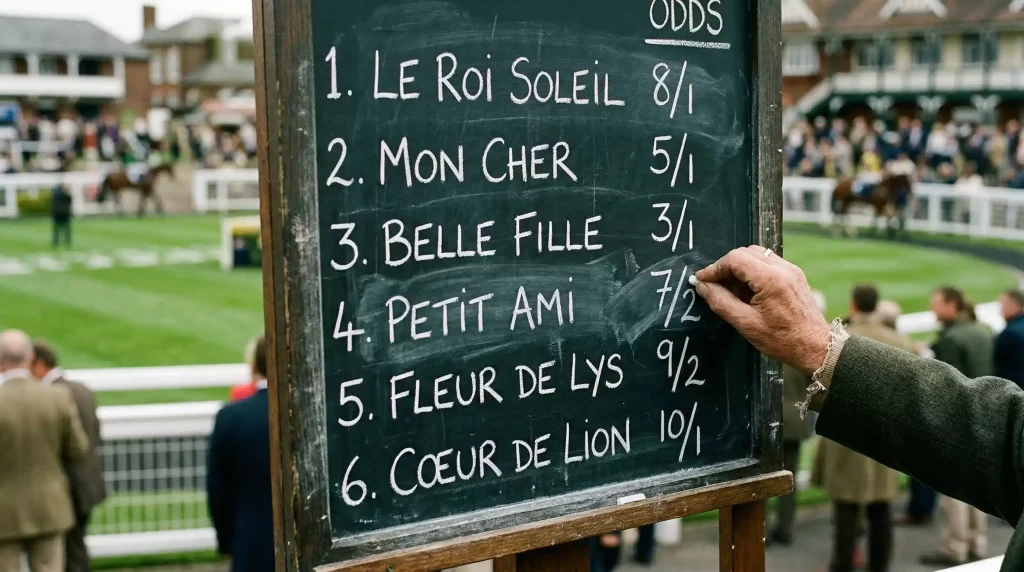
Every horse racing result in the UK carries a three-letter code that determines how most bets are settled: SP. The Starting Price is the official odds of a horse at the exact moment the race begins, and it has been the bedrock of British betting for well over a century. Whether you backed a 3/1 shot at 9am or let your bookmaker take the SP, that final number printed next to the winner’s name is the one that counts when money changes hands.
SP in horse racing is not a guess, not an algorithm, and not a marketing tool. It is a price derived from a live, physical market that exists on every racecourse in Britain. Understanding how it works, how it differs from the prices you see online hours before a race, and why it remains the industry’s default settlement mechanism is fundamental to reading results with any real confidence. If you have ever wondered why your payout did not match the odds you saw that morning, SP is almost certainly the answer.
This matters more than it might seem. According to the Gambling Commission’s Industry Statistics for the year ending March 2026, remote betting on horse racing generated £766.7 million in gross gambling yield. A significant share of that total is settled at SP. Getting to grips with this number is not optional — it is the entry fee for making sense of any UK racing result.
How a better price is protected is in best odds guaranteed.
How SP Is Determined
The Starting Price is set by an independent organisation called the Starting Price Regulatory Commission, which oversees the process on behalf of the British Horseracing Authority. The mechanism is surprisingly analogue. At every racecourse, a group of on-course bookmakers operate a live market in the minutes before each race. They stand in a line, chalk boards in hand — or, more commonly now, digital screens — adjusting their prices in response to the money being wagered by punters at the track.
An SP reporter, appointed by the Commission, watches this on-course market and records the prices being offered at the precise moment the starter lets the field go. The SP is not a single bookmaker’s price. It is a representative reflection of the market as a whole at the instant of the off — typically calculated as the modal price (the most commonly offered odds) among those on-course layers. If three bookmakers are showing 5/1 and two are showing 9/2, the SP is returned at 5/1.
This is a crucial distinction. The SP is not set by Betfair, not by Bet365, and not by any other online operator. It is a product of the racecourse ring, a market that has existed in some form since the Victorian era. The online prices you see in the morning are each bookmaker’s own assessment of probability, shaped by their liability management, promotional strategies, and the weight of money coming in from customers. The SP is independent of all that.
There is a timing element worth understanding too. The on-course market does not open at dawn. It typically becomes active 10 to 15 minutes before the off, and prices can shift rapidly. A well-backed horse may shorten from 6/1 to 7/2 in the final minutes. A drifter — a horse attracting little support — may push out from 10/1 to 14/1. All of this happens live, in the ring, and the SP captures the final state of that live market.
The scale of what this price anchors is enormous. The SP serves as the default settlement price for the vast majority of bets placed on British racing — from the smallest Tote ticket to the largest credit account wager. It is, in effect, the exchange rate of the sport.
SP vs Early Prices and Exchange Odds
If you opened a betting app at 8am and took 5/1 about a horse in the 3.30 at Kempton, that price was not the SP. It was the bookmaker’s early price — sometimes called an ante-post or early market price — and it reflects a combination of the firm’s tissue (their private assessment of each horse’s chance), market intelligence, and their desire to attract early money. Early prices are commercial products. The SP is a market outcome.
The gap between the two can be significant. A horse that opens at 10/1 in the morning might return an SP of 6/1 if substantial support arrives at the course, or drift to 16/1 if money dries up. This is why the phrase “take the price” exists in racing parlance: if you believe a horse is overpriced at 10/1 and you take that price, you are banking on the SP being shorter. If you let it ride at SP, you accept whatever the market delivers at the off.
Betting exchanges add another layer. On Betfair, for example, the price is set by other punters, not by the house. Exchange prices update continuously and often diverge from both the early bookmaker price and the eventual SP. A horse trading at 4.0 (3/1) on the exchange five minutes before the race may return an SP of 7/2 at the course. Neither price is wrong — they simply reflect different pools of opinion and different market mechanics.
For the bettor checking results, the distinction matters practically. If you placed your bet at a fixed early price, your payout is locked in regardless of what the SP turns out to be. If you chose SP — either deliberately or because you did not take a price — you get whatever the on-course market delivered. There is no negotiation after the fact.
One common misconception is that SP is always worse than the early price. It is not. Horses that are weak in the morning market but attract late support at the course can return an SP shorter than the early price, meaning the SP punter actually got less value. But horses that drift late — perhaps because of a going change or stable whispers drying up — can return an SP longer than anything available that morning. The SP is volatile precisely because it is a live market, and live markets do not care about your morning confidence.
Why SP Matters for Settling Bets
When a race finishes, the result is confirmed through the weighing-in process, and bets are settled. For any wager placed at SP, the payout is calculated using the returned Starting Price — the number published in the official result. This is the standard across every licensed bookmaker in Britain, and it applies to all bet types: singles, each-way, accumulators, Lucky 15s, and everything in between.
The Gambling Commission’s survey data for 2026 found that 7% of UK adults had bet on horse racing in the previous four weeks during the April-to-July period, a figure that spikes around major festivals. Many of those punters — particularly casual or once-a-year bettors — default to SP without fully realising what that means. They see a horse’s name in the result, see “SP 4/1,” and assume it was always 4/1. In reality, that price may have been 6/1 in the morning and 9/2 on the exchange. The SP is the final word, not the first.
Best Odds Guaranteed changes this dynamic for those who plan ahead. Under BOG, if you take an early fixed price and the SP turns out to be higher, the bookmaker pays you at the SP instead. It is, in theory, the best of both worlds: a floor price locked in early, with upside if the market moves in your favour. Not every firm still offers BOG on every race — the concession has been scaled back in recent years as margins tighten — but where it applies, it makes the relationship between early price and SP directly relevant to your payout.
For bets settled at SP, the key practical takeaway is this: if you want to know exactly what you stand to win before the race, do not take SP. Take a fixed price. If you are comfortable with market risk, or if you believe the on-course market will deliver a better price than what is available early, then SP is a rational choice. Either way, when you look at a result and see those two letters next to the odds, you are looking at the verdict of the oldest live betting market in the world. It may not always be the best price you could have had, but it is always the honest one.
Created by the "UK Horse Racing Results" editorial team. The wider context is set out in today's UK horse racing results.
