
Horse Racing Form Figures Explained — Numbers, Letters, Symbols
 Available in US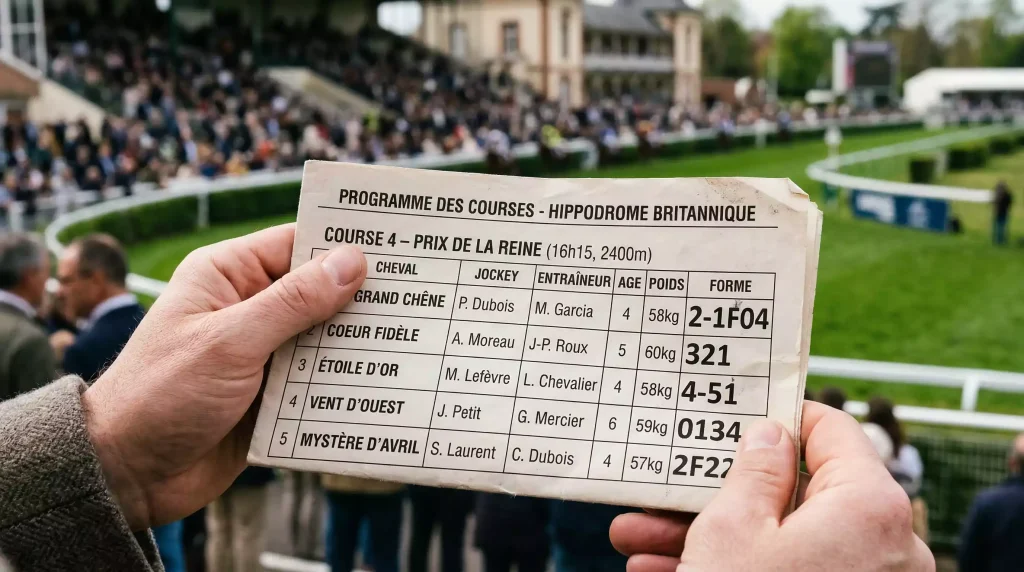
A horse’s entire racing career is compressed into a single line of numbers, letters and symbols. That line — the form figure — appears next to every runner on a racecard and in every set of results across UK racing. Learn to read it and you unlock a shorthand history that tells you where a horse finished, when it last ran, whether it fell, and how its current season compares to the last. Ignore it and you are essentially betting blind.
Horse racing form figures explained in plain terms: the string reads from left to right, oldest run to most recent, with each character representing one race. A sequence like 32-1F04 is not random noise. It is six races of context packed into seven characters, separated by a season break, and it contains more actionable intelligence than most pre-race previews. The system was designed for speed — so that a punter scanning a 12-runner handicap can assess every horse in under a minute — and it works, once you know the code.
Approximately 35% of the roughly 10,000 annual races in Britain are held over jumps, and the rest are Flat. The form system covers both codes identically, though jump racing introduces a few extra letters that Flat punters rarely encounter. What follows is a complete breakdown of every element you will see in a UK form figure.
The letters among them are listed in the abbreviations guide.
Reading Numbers 1–9 and 0
Each digit represents the horse’s finishing position in a single race. The most recent run is on the far right; the oldest is on the far left. So a form line of 4213 means the horse finished 4th, then 2nd, then 1st, then 3rd — with that 3rd-place finish being its latest outing.
Numbers 1 through 9 are self-explanatory. A 1 means the horse won. A 9 means it finished ninth. The number 0, however, trips up newcomers. It does not mean the horse did not run. It means the horse finished outside the first nine — tenth or worse. In a large-field handicap with 16 runners, finishing tenth is not necessarily a disaster, but in a five-runner novice hurdle, a 0 signals something went badly wrong.
Context is everything. A form line of 0000 looks dire, but if all four runs were in Grade 1 company against the best horses in training, those zeros carry far more weight than a 1111 sequence compiled in Class 6 sellers. The numbers tell you where a horse finished; they do not tell you who it was running against, what trip it was racing over, or what the ground was like. That information lives in the full result, not the form figure. The figure is the headline; the result is the article.
One small but important convention: when form is displayed on a racecard (before the race), the sequence shows past performances. When it appears in a result (after the race), the latest figure will have been updated to include today’s finishing position. Some platforms bold the latest figure to draw attention to it. Others simply append it to the end of the string.
The average field size on the Flat in 2026 stood at 8.90 runners per race, according to the BHA’s annual Racing Report. Over jumps, it was 7.84. These numbers matter for interpreting form: in smaller jump fields, a 0 is more damning than in a packed Flat handicap. The digit is identical, but its meaning shifts with the competitive environment.
Separators and Symbols
Between the numbers and letters, you will encounter two key separators. The hyphen (-) marks the boundary between the current season and the previous one. Everything to the right of the hyphen is this season; everything to the left is last season. A form string of 21-430 means the horse finished 2nd and then 1st last season, and has run three times this season with finishes of 4th, 3rd, and most recently outside the top nine.
The forward slash (/) indicates a longer gap — typically a break of more than one full season. If a horse has been off for two years due to injury, you might see something like 12/3-1. The 1 and 2 are from two or more seasons ago, the slash marks the extended absence, and the 3-1 covers last season and the current one. A slash is always worth pausing over because it signals interrupted momentum. Horses returning from long layoffs are notoriously unpredictable, regardless of what they achieved before the break.
There is also a typographical convention that varies by platform. On some racecards and result pages, a bold number indicates a run on an all-weather surface (if the card is a turf Flat race) or a point-to-point (if the card is a National Hunt race). This is not universal, and some digital platforms use colour coding instead. But if you see a bold digit in a form string on Racing Post or a printed racecard, it flags a surface or code switch. A horse with strong bold figures but weak standard ones may simply prefer artificial ground to turf, or vice versa.
Jump racing’s share of the annual fixture list — around 35% of all British races — means the separator system gets heavy use during the winter months, when horses often have seasonal form stretching back a year or more. Flat horses tend to accumulate form in tighter bursts, with fewer separators in their strings.
Letters: P, F, U, R, S, B, D, C, O
When a horse does not complete a race, a letter replaces the number. Each letter tells a specific story, and in jump racing, where falls and unseats are part of the landscape, you will encounter them regularly.
P stands for pulled up. The jockey made a deliberate decision to stop riding, usually because the horse was struggling, injured, or exhausted. A horse pulled up in a three-mile chase was not going to finish — the jockey chose safety over a pointless completion. From a form perspective, a single P is not automatically damning. Two or three in succession is a pattern worth noting.
F means the horse fell. It hit the ground — typically at a fence or hurdle. A fall can be caused by a jumping error, interference, or fatigue. Unlike P, a fall is involuntary. The horse did not choose to stop; it was brought down by gravity. Repeated Fs raise serious questions about a horse’s jumping ability.
U stands for unseated rider. The horse made a mistake — usually at an obstacle — and the jockey was dislodged, but the horse itself stayed on its feet. The distinction between F and U matters: a horse that unseats may still be a decent jumper that had one careless moment, while a faller hit the deck entirely.
R means refused. The horse decided, unilaterally, that it was not going to jump a fence or start the race. This is a behavioural issue, not an athletic one. Refusals at specific fences can indicate that a horse has lost confidence in its jumping, or that it simply does not want to be there. Trainers take refusals seriously.
B means brought down. The horse fell or was stopped because of another horse’s fall — it was a victim, not the cause. A B in the form does not reflect badly on the horse itself, though it does mean it missed the experience of completing the race.
S stands for slipped up, typically on the Flat. The horse lost its footing — on a bend, at the start, or on deteriorating ground. It is rare and usually track-condition related. D means disqualified after finishing — the horse crossed the line but was removed from the placings. C stands for carried out, meaning the horse was forced wide by another runner and left the track. O means ran out — the horse voluntarily left the racecourse, usually by ducking out at a fence.
Two of these letters — F and P — are the most consequential for bet settlement. If your horse is recorded as F, P, U, B, R, or any other non-completion code, it is treated as a loser for betting purposes. There is no ambiguity. The result says your horse did not finish, and your stake is gone.
Using Form to Evaluate Today’s Runners
The form figure is a starting point, not a conclusion. A sequence of 1112 tells you the horse has been in excellent form, but it does not tell you the class of those races, the ground conditions, the distances, or whether the jockey was the same. The full result for each of those runs fills in the picture. The form figure gets you to the right question; the result gives you the answer.
When assessing today’s runners, work right to left. The most recent run is the most relevant. A horse whose last three figures are 321 is on an upward trajectory. One reading 123 is heading the wrong way. But be careful with seasonal breaks: a -1 at the start of a new campaign only tells you the horse won first time out. It does not tell you whether it has maintained that fitness.
Improving form is the easiest pattern to spot and the most reliable to follow. A horse moving from 6 to 4 to 2 in consecutive runs is clearly finding its level. A horse moving from 1 to 3 to 7 is losing its way. Neither sequence guarantees the trend will continue, but the trend itself is real. The best punters combine form figures with the detailed data in results — winning distances, in-running comments, speed ratings — to build a three-dimensional picture of each horse. The form figure is the two-dimensional sketch that tells you where to look.
Created by the "UK Horse Racing Results" editorial team. The wider context is set out in today's UK horse racing results.
