
National Hunt vs Flat Racing — How They Differ and Why It Matters
 Available in US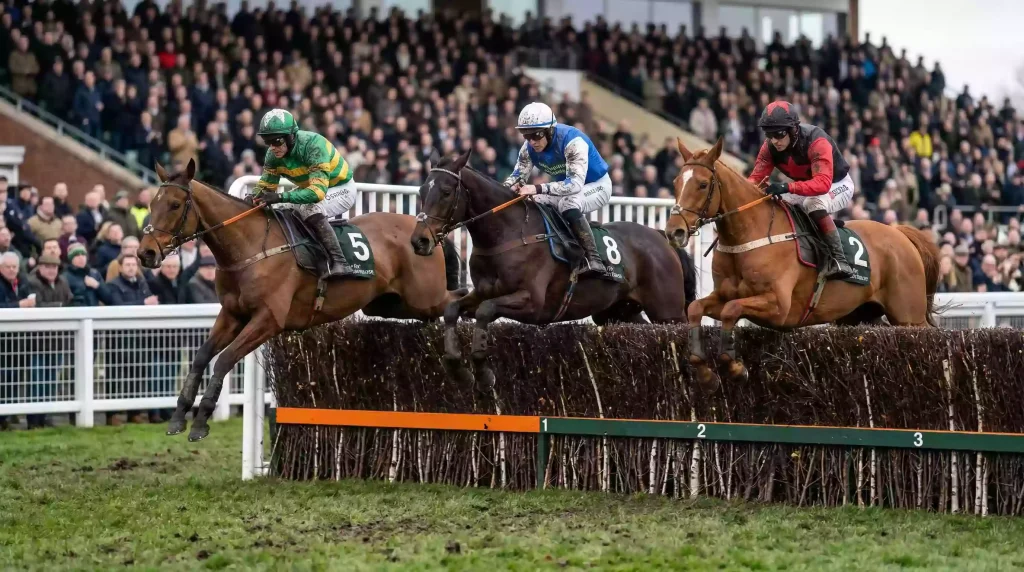
British horse racing operates under two codes that share a governing body, a calendar, and a betting ecosystem — but almost nothing else. National Hunt vs Flat racing is not a branding distinction. It is a structural one. The horses are different ages, the distances are different orders of magnitude, the obstacles either exist or they do not, and the results carry entirely different patterns of abbreviations, margins and non-completions. If you read Flat results the same way you read jump results, you will misread the form. If you bet on one code using instincts built in the other, you will lose money doing it.
Roughly 35% of the approximately 10,000 races staged in Britain each year are held over jumps, with the remaining 65% on the Flat, according to research published in the BHA’s 2026 Racing Report. Those two segments coexist on the same fixture list but produce fundamentally different types of results. Understanding how and why they differ is the first step towards reading any British racing result with genuine clarity.
The third code runs on sand: all-weather racing.
Obstacles, Distances, Speed
The defining feature of National Hunt racing is the obstacle. Steeplechases use fences — solid birch structures that stand at least four feet six inches tall. Hurdles are smaller, more flexible frames made of brush, standing around three feet six inches. National Hunt flat races, confusingly, have no obstacles at all — they are run on the hurdle course with the hurdles removed, serving as introductions for young jump-bred horses. These three race types all fall under the NH umbrella.
Flat racing, by contrast, involves no jumping whatsoever. Horses run on turf (from approximately April to October) or on all-weather surfaces (year-round). The distances are shorter. The shortest Flat race in Britain is five furlongs — about 1,000 metres — and the longest is roughly two miles and five furlongs. A five-furlong sprint on the Flat takes about 58 seconds. A two-mile-four-furlong steeplechase takes upwards of five minutes.
This distance differential shapes everything that follows. Flat racing is primarily a test of speed and acceleration, with tactical decisions concentrated into the final two or three furlongs. Jump racing is a test of stamina, jumping ability, and the capacity to sustain effort over distances that would destroy a typical sprinter. The horses that excel in each code are often bred for entirely different physical attributes — a long-striding, rangy type for the jumps; a compact, powerful frame for the Flat.
The obstacle element introduces a variable that simply does not exist on the Flat: the possibility of a horse not finishing the race because it fell, was brought down, unseated its rider, or refused to jump. On the Flat, virtually every horse that starts a race finishes it. Over jumps, non-completions are routine. This single fact produces the most visible difference in how results from the two codes look on a screen.
Seasonal Patterns
The two codes operate on overlapping but distinct seasonal rhythms. The turf Flat season in Britain runs from mid-April to early November, with the Classic races — the 1,000 Guineas, 2,000 Guineas, Oaks, Derby and St Leger — concentrated between May and September. All-weather Flat racing continues year-round, filling the winter months at venues like Lingfield, Kempton and Wolverhampton.
The National Hunt season runs from October through to late April. Its showpiece events — the Cheltenham Festival in March, the Grand National meeting at Aintree in April — sit at the tail end of the campaign. Between late April and early October, jump racing scales back dramatically, with only a handful of summer fixtures at courses like Market Rasen and Newton Abbot.
The average field size in 2026 reflected these structural differences. On the Flat, it stood at 8.90 runners per race. Over jumps, it was 7.84. Smaller NH fields are partly a function of the horse population — there are simply fewer jump horses in training — and partly a consequence of the greater physical demands of the sport, which limit how often a horse can race. A busy Flat horse might run 10 to 15 times in a season. A busy jumper might manage six or seven.
How Results Differ in Practice
Open a Flat result for a six-furlong sprint at Newmarket and you will typically see every runner accounted for with a finishing position. The margins will be tight — heads, necks, half-lengths. The winning time will be around 70 seconds. There will be no PU, no F, no UR. The in-running comments will describe positioning and acceleration in the final furlong. The form figures for each horse will be a clean string of numbers.
Open a National Hunt result for a three-mile handicap chase at Haydock and the picture shifts. Of the 12 runners, perhaps eight will have finishing positions. The other four will have letters: two pulled up, one fell, one unseated rider. The winning margin might be five lengths. The in-running comments will describe jumping errors at the fourth-last, the pace collapsing after the third-last, and a horse weakening on the run-in to the final fence. The form figures will be peppered with Ps and Fs alongside the numbers. When the margin is contested or the manner of running draws scrutiny, the BHA’s stewards’ enquiry process — in which the panel reviews at least four camera angles of the race — applies equally to both codes, though it is invoked more frequently over jumps where interference at obstacles is common.
Ground conditions are relevant to both codes but affect jump racing more acutely. Heavy going on a chase course slows the pace, increases the risk of falls, and stretches the distance between finishers. Firm ground on a Flat track quickens the pace and compresses the margins. The going description in a result — which you should always check — carries different weight depending on the code. A horse that won on soft ground over fences has demonstrated one type of ability. A horse that won on firm ground over five furlongs has demonstrated something else entirely.
Why It Matters for Your Bets
Place terms for each-way bets are identical across codes: the standard fractions apply regardless of whether the race is Flat or NH. But the practical effect differs. With larger average fields on the Flat, there are more qualifying places in handicaps, and the race is less likely to be voided or reduced to a non-competitive contest by non-completions. In a small-field NH novice chase with five runners, if two fall, your each-way bet is effectively running against two remaining opponents. The value calculation changes.
Form interpretation also diverges. On the Flat, a horse beaten two lengths is close to the winner. Over jumps, a horse beaten two lengths may have been flattered by the collapse of rivals ahead of it. Conversely, a horse pulled up at the third-last may have been going better than the winner at the time — the form figure shows P, but the in-running comments tell a different story. Jump form requires more excavation. Flat form is more numerical, more linear, and more immediately legible.
None of this makes one code superior to the other. They are different sports sharing a common infrastructure. The bettor who recognises that distinction — and adjusts their reading of results accordingly — has an edge over the one who does not.
Created by the "UK Horse Racing Results" editorial team. The wider context is set out in today's UK horse racing results.
