
Horse Racing Results Archive — Access Years of UK Data
 Available in US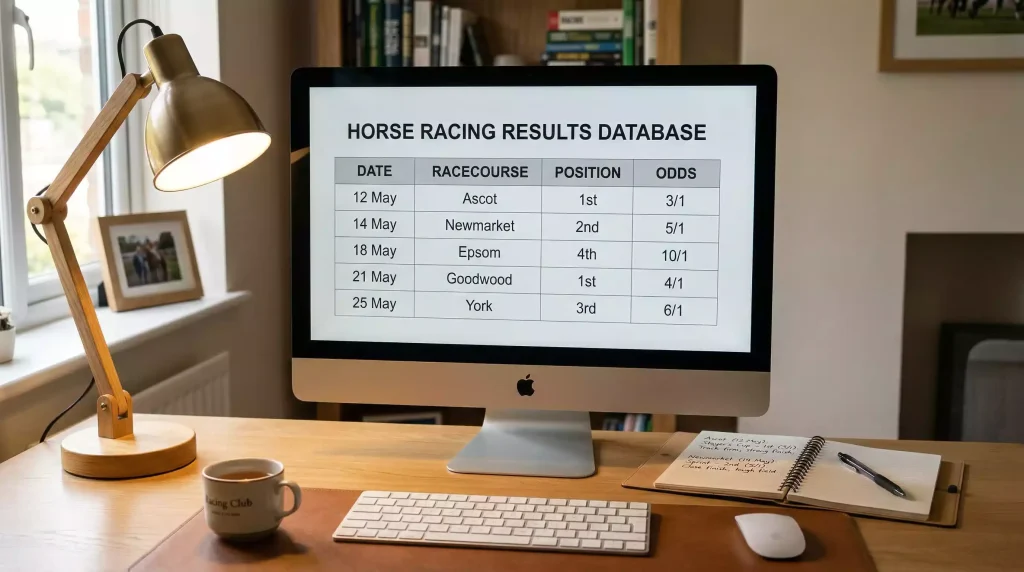
Yesterday’s results help you assess tomorrow’s runners. But what about the results from last month, last year, or last decade? The horse racing results archive — the accumulated record of every race run in Britain — is where casual form study ends and serious research begins. Within these databases sit millions of individual race records: finishing positions, Starting Prices, winning distances, going descriptions, sectional times, and in-running commentaries stretching back years. Knowing how to access them, what formats they come in, and what you can actually do with the data is what separates the recreational punter from the analyst.
Britain stages roughly 1,460 fixture days per year, each producing anywhere from five to eight races. Over a decade, that is more than 100,000 individual race results, each with a full complement of data points. The archive exists. The challenge is getting it into a form you can work with.
The most recent card is yesterday's results.
Major Archive Providers
Racing Post maintains the largest publicly accessible results archive in British racing. Its database covers more than a decade of results, searchable by date, course, horse name, trainer, jockey and race type. Each result includes the full finishing order, SP, distances, in-running comments and weight carried. For most users, this is the default archive — it is free to search, though some premium features require a subscription. The depth of data is exceptional, and the integration with racecards, form guides and ratings makes it a genuine one-stop tool.
Timeform’s archive stretches back several decades and includes the company’s proprietary performance ratings alongside the standard result data. A Timeform rating is a numerical assessment of each horse’s performance in a given race, calibrated to a consistent scale. This means you can compare a horse’s run in a handicap at Wolverhampton last Tuesday with a performance at Royal Ascot three years ago and get a meaningful comparison. The archive is available to subscribers and is the most analytically rich dataset available to the general public.
RacingFormBook occupies a different niche. It provides results data specifically formatted for download — CSV files that can be loaded into spreadsheets, databases, or custom analysis tools. The site offers both racecard and results files, with a unique ID for each race that allows users to link pre-race data to post-race outcomes. For anyone building a personal ratings system or testing betting strategies against historical results, RacingFormBook is the primary supplier of raw data. It also offers a free database builder app — the RaceHorseFormBuilder — that allows subscribers to create their own private handicap ratings using historical results from 2016 onwards.
The BHA itself publishes certain aggregate statistics on its Racing Statistics page, including off-time data, fixture lists and handicap-related metrics. This is not a results archive in the traditional sense — you cannot look up individual race results — but it provides the macro-level context (total fixtures, total runners, field sizes by code) that frames the data you find in the dedicated archives.
Data Formats and Downloads
The standard format for downloadable racing results data is CSV — comma-separated values — which can be opened in Excel, Google Sheets, or any database application. RacingFormBook is the most established supplier of CSV data for British and Irish racing, offering results in both their proprietary “Duo” format and the more widely used SFF (standard form file) format. Each row in a results CSV represents one runner in one race, with columns for finishing position, SP, weight, going, distance, trainer, jockey, and a race identifier that links back to the original racecard.
For users with more technical ambitions, the RacingFormBook Access database provides a pre-built relational structure containing all UK and Irish results from 2016 to the present. This allows SQL-style queries — “show me all horses trained by X that won on soft ground at distances over two miles in the last three years” — without needing to build the database from scratch.
Some data providers offer API access for programmatic queries, though this is less common in the UK market than in North America, where Equibase provides structured data feeds to licensed clients. In Britain, the closest equivalent for the amateur researcher is the combination of CSV downloads and a local database, supplemented by manual queries on Racing Post or Timeform for specific races.
Building a Personal Ratings System
The archive’s ultimate value lies in what you build with it. A personal ratings system — sometimes called a private handicap — assigns a numerical performance score to each horse based on its race results. The simplest versions use raw finishing times, adjusted for the class of race and the going. More sophisticated systems incorporate speed figures, sectional times, weight carried, and a points-per-length adjustment for beaten distances.
The concept of the A/E index (actual versus expected winners) is particularly useful for testing a ratings system against reality. You calculate how many winners your top-rated horses produced, compare it to how many winners would be expected given the odds, and if the actual number exceeds the expected number, your system is adding value. An A/E index above 1.00 indicates that your ratings are identifying winners at a rate the market underestimates. Below 1.00, and the market is smarter than your model.
Average field sizes in 2026 — 8.90 on the Flat and 7.84 over jumps — provide important context for any ratings exercise. In smaller fields, the margin for error in a rating system is tighter because there are fewer horses to separate. In larger fields, a ratings edge can be more profitable because the market is less efficient at pricing the full field accurately. Historical field size data, available in the BHA’s annual reports, allows you to calibrate your expectations by race type and code.
Legal and Usage Notes
Racing data in Britain is subject to intellectual property protections. The raw factual content of a race result — who won, the SP, the distances — is generally not copyrightable. However, the specific compilations, formats and proprietary analyses layered on top of that data are. Timeform ratings, Racing Post Ratings, and Proform Power ratings are all proprietary products. You can use the underlying result data for personal research, but redistributing proprietary ratings or datasets without permission is a breach of the provider’s terms of service.
Equibase, the official statistical provider for North American racing, explicitly prohibits automated scraping of its site. British data providers take a similar stance. If you are downloading CSV files from RacingFormBook or accessing Timeform’s archive, you are doing so under a licence that permits personal use. Commercial redistribution — selling your own product built on their data — requires a separate agreement.
For academic researchers, the BHA and HBLB have historically been supportive of data requests made for legitimate research purposes. The Equine Veterinary Journal study on jump racing fatalities, for instance, used data extracted from the Weatherbys racing database and the BHA’s injury database, both provided under research agreements. If you are conducting formal research, approaching the relevant bodies directly is often more productive than trying to assemble the data yourself from commercial sources.
Created by the "UK Horse Racing Results" editorial team. The wider context is set out in today's UK horse racing results.
