Best Odds Guaranteed in Horse Racing — How It Works
Best Odds Guaranteed is a concession that some bookmakers offer on horse racing: if you take an early price and the Starting Price at the off is higher, the bookmaker pays you at the SP instead. You keep the floor of the early price, but gain the upside of a drifting market. On paper, it is a free upgrade. In practice, best odds guaranteed in horse racing has become less generous, less universal and less reliable than it was five years ago — and the reasons for that contraction tell you as much about the state of the industry as any annual report.
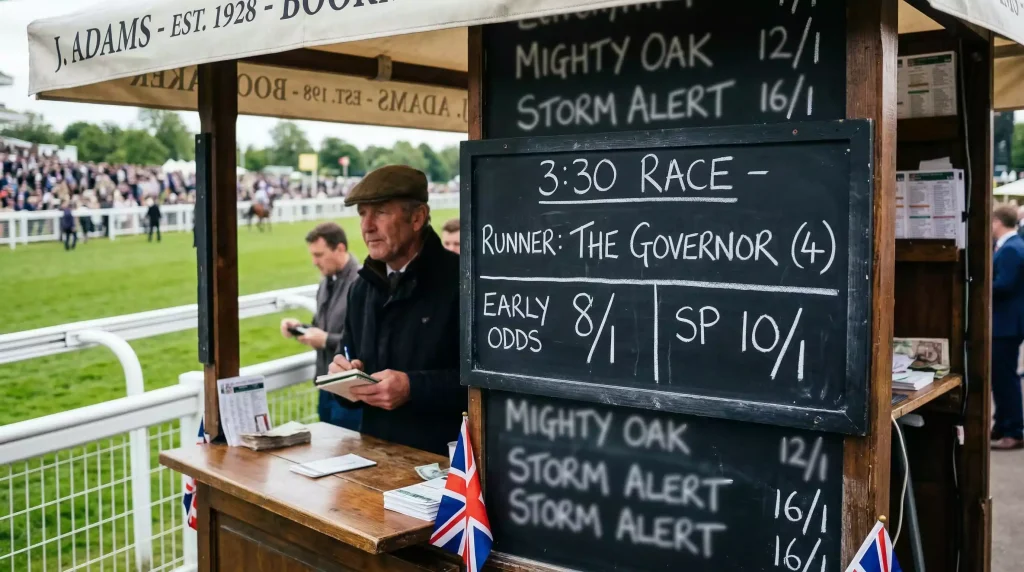
The mechanism is simple enough. You back a horse at 5/1 on Wednesday morning. By the time the race goes off on Saturday, the on-course market has drifted and the SP is returned at 8/1. Under BOG, your bet is settled at 8/1. If the SP had been shorter — say 3/1 — your bet settles at your original 5/1. Either way, you cannot lose compared to the price you took. The bookmaker absorbs the difference, which across thousands of bets per day adds up to a significant cost.
How BOG Interacts with SP
The relationship between BOG and SP is straightforward in principle but varies in execution. Every BOG offer depends on the Starting Price being formally returned at the racecourse. This means BOG only applies to races where an SP is recorded — essentially all British and Irish races, but not necessarily races in France, the UAE or other international jurisdictions sometimes offered by UK bookmakers.
When you take a price with BOG, the bookmaker is effectively writing you an option. If the SP exceeds your price, they exercise the option on your behalf, upgrading the settlement to the higher number. If the SP is lower, the option expires worthless and your original price stands. From the bookmaker’s perspective, this is a cost of acquisition — a way to attract customers who would otherwise wait for the SP or shop around for the best price elsewhere.
The cost is not trivial. According to the Gambling Commission, gross gambling yield from remote horse racing betting totalled £766.7 million in 2026/25. BOG payouts come directly out of that yield, reducing the bookmaker’s margin on every qualifying bet where the SP moves against them. In periods when the market is volatile — late withdrawals, sudden going changes, unexpected support for a horse at the course — the BOG cost spikes.
Which Bookmakers Offer BOG
The availability of Best Odds Guaranteed has contracted over the past three years. At the height of the promotional arms race — roughly 2018 to 2021 — virtually every major licensed bookmaker in Britain offered BOG on all UK and Irish horse racing, all day, every day. It was table stakes for competing in the market.
That is no longer the case. Several operators have restricted BOG to selected races, selected meetings, or selected times of day. Others have imposed a maximum payout differential — if the SP exceeds your price by more than a certain amount, the BOG upgrade is capped. A few have withdrawn the offer entirely on specific bet types, such as ante-post wagers or bets placed through certain promotional channels.
The landscape changes frequently, and any specific list of BOG-offering bookmakers would be outdated within weeks. The more useful approach is to check the terms for each operator at the point of placing your bet. Look for the BOG badge on the racecard or bet slip. If it is there, the concession applies to that bet. If it is absent, assume it does not. Do not rely on memory or assumption — operators adjust their BOG policies race by race and day by day.
BOG and the Declining Promotions Trend
The retreat from universal BOG is part of a broader contraction in bookmaker concessions. Betting turnover on British horse racing has been falling sharply. The total stood at £8.73 billion for 2023/24, a decline of 16.3% from £10 billion in 2021/22. Adjusted for inflation, the real drop is closer to 26% over that three-year period. Fewer bets, at lower average stakes, from a shrinking pool of higher-staking customers — the economics no longer support the level of promotional generosity that characterised the pre-2022 market.
Affordability checks, introduced under Gambling Commission guidance, have pushed some high-staking customers away from licensed operators entirely. These were the customers most likely to take early prices, most likely to benefit from BOG, and most likely to notice when the concession was withdrawn. Their departure reduces the competitive pressure on bookmakers to maintain the offer. If the customers who valued BOG most are no longer there, the incentive to provide it weakens.
For the remaining customer base — predominantly recreational punters placing smaller stakes — the loss of BOG is less acutely felt but still meaningful. A recreational punter who backs a horse at 6/1 in the morning and sees it returned at 10/1 has just lost £40 of notional value on a £10 bet. They may never know, because they did not check the SP against their early price. But the value erosion is real, and it compounds over time for anyone who bets regularly.
When BOG Does Not Apply
Even where BOG is offered, there are exclusions. Ante-post bets — those placed before the final declaration stage — are almost universally excluded. The rationale is that ante-post prices carry their own risk premium (if the horse does not run, the stake is lost), and that risk is the bettor’s trade-off for potentially better odds. Adding BOG to ante-post bets would give the punter both the risk premium and the downside protection, which bookmakers are not prepared to offer.
Tote pool bets are excluded because the Tote operates its own pari-mutuel system — there is no SP in the traditional sense, and the payout is determined by the pool dividend after the race. Bets placed with free bet tokens or promotional credits may also be excluded, depending on the terms of the specific promotion.
Enhanced odds promotions — “Bet £10 on Horse X at 30/1” — override BOG because the enhanced price is already substantially above the likely SP. If the horse’s SP is 8/1, the bookmaker is not going to pay you at 8/1 when you already have a promotional 30/1. The enhanced odds and BOG are mutually exclusive, and the enhanced price takes precedence.
Finally, some operators exclude BOG on bets placed through certain channels — in-shop but not online, or via the app but not the website. These channel-specific exclusions are rare but exist, and they are always documented in the terms and conditions. The recurring theme with BOG is that the headline promise is simple — you get the better price — but the small print determines whether that promise actually applies to your specific bet, on your specific horse, at your specific bookmaker, on any given day.