
Each-Way Betting Results in Horse Racing Explained
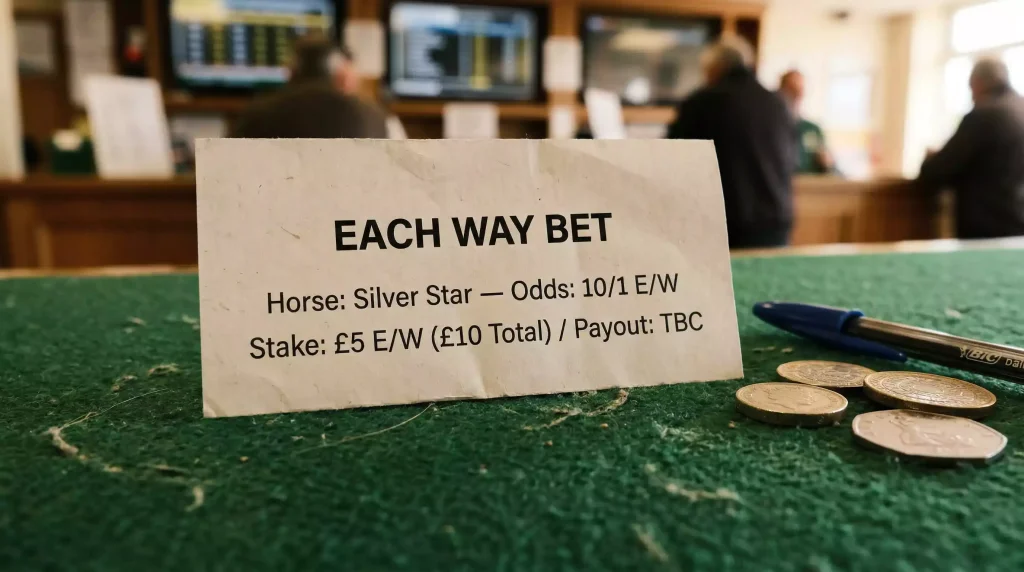
An each-way bet is two bets in one: a win bet and a place bet, both on the same horse, at the same stake. If the horse wins, both parts pay out. If it finishes in a designated place — second, third, or sometimes fourth — only the place part pays, at a fraction of the SP. That fraction, and the number of places paid, depends on the field size and the race type. Getting these mechanics wrong is one of the most common ways punters miscalculate their expected returns from each-way results in horse racing, and the confusion usually starts with not understanding the place terms.
Each-way betting accounts for a substantial portion of all horse racing wagers placed in Britain. The Gambling Commission’s annual report for 2026/25 recorded £766.7 million in gross gambling yield from remote horse racing betting alone — a figure that includes millions of each-way bets settled daily. Understanding exactly how the result of a race determines your each-way payout is not academic. It is directly financial.
Standard Place Terms by Field Size
Place terms are not arbitrary. They follow a standardised scale that depends on how many horses run in the race and, in some cases, the type of race. The core structure is as follows.
In races with two to four runners, most bookmakers offer win-only betting. There is no each-way option because the field is too small to make a meaningful place market. In races with five to seven runners, the standard terms are one-quarter of the odds for the first two places. So if your horse was 8/1 and finished second, the place part of your each-way bet pays at 2/1 (8 divided by 4). Your win bet loses, but the place bet returns.
In non-handicap races with eight or more runners, the standard terms extend to three places at one-quarter the odds. In handicap races with 12 to 15 runners, the same three-place structure typically applies. The real value shift comes in handicaps with 16 or more runners: here, the standard terms become four places at one-quarter or sometimes one-fifth of the odds. Large-field handicaps — the Cesarewitch, the Cambridgeshire, big Saturday handicap hurdles — are the races where each-way betting becomes most tactically interesting.
The average field size across British Flat racing in 2026 was 8.90 runners per race; over jumps, it was 7.84. These averages matter because they tell you that the typical race lands right around the boundary between two-place and three-place terms. A race that attracts eight runners offers three places. One that draws only seven offers two. That single extra runner can mean the difference between your each-way bet paying out and returning nothing. Before placing any each-way bet, check the number of declared runners. Not the number of entries — the number that have actually been declared to run.
How Results Determine Each-Way Payouts
The payout calculation is mechanical once you know the terms. Your stake is doubled — half goes on the win, half on the place. If the horse wins, the win part pays at the full SP and the place part pays at the fractional SP. If the horse places but does not win, only the place part pays.
A concrete example. You place a £10 each-way bet on a horse at SP 10/1 in a 12-runner handicap (standard terms: one-quarter the odds, three places). Your total outlay is £20 (£10 win, £10 place). If the horse wins, you receive £110 from the win part (£10 at 10/1 plus your stake) and £35 from the place part (£10 at 10/4, which is 2.5/1, plus your stake). Total return: £145, profit £125. If the horse finishes third, you receive nothing from the win part and £35 from the place part. Total return: £35, loss of £-15 on the overall bet despite your horse finishing in the places.
This is the trap that catches many each-way bettors. A placed horse at short odds can return less than the total stake. If you back a 3/1 shot each-way and it finishes second, the place part pays at 3/4 — less than evens. Your £10 place bet returns £17.50 (£7.50 profit plus £10 stake), but you have already lost the £10 win part. Net result: a loss of £2.50. Each-way betting on short-priced horses in small fields is often poor value for exactly this reason.
Dead heats complicate matters further. If two horses dead-heat for second in a three-place race, your bet is settled at half the stake for the place part. The logic is that two horses share one place, so each gets half of it. If the dead heat involves the winner, your win bet pays at half stakes and your place bet pays in full.
Extra Places Promotions
Many bookmakers routinely offer extra places on selected races — paying out on four, five or even six places in big-field events that would normally only pay three. These promotions are competitive tools designed to attract each-way bettors, and they can meaningfully alter the value equation. A race with 20 runners paying five places at one-quarter the odds is a very different proposition from the same race paying only three.
The BHA’s 2026 Racing Report noted that betting customers are increasingly concentrating their activity on the bigger racedays — the Premier fixtures where prize money is highest and fields are largest. These are precisely the races where extra-place offers tend to be most generous, because bookmakers compete hardest for the recreational punter’s attention at marquee events. Cheltenham Festival handicaps, Royal Ascot sprints and big Saturday racing all attract aggressive extra-place promotions.
The tactical implication is clear. If a bookmaker is paying five places on a 20-runner handicap, the effective each-way value of a long-priced horse improves substantially. A 25/1 shot that finishes fifth returns nothing under standard terms but yields a place payout under the promotion. This does not make the bet inherently good — the horse still needs to finish in the places — but it shifts the breakeven point in the bettor’s favour.
Each-Way in National Hunt vs Flat
The structural differences between the two codes have practical consequences for each-way strategy. National Hunt fields are smaller on average — 7.84 runners versus 8.90 on the Flat — which means fewer races qualify for three-place terms and even fewer reach the 16-runner threshold for four places. Each-way betting in jump racing often involves smaller fields and tighter margins.
However, the non-completion factor in jump racing creates its own dynamic. In a 10-runner steeplechase, if three horses fall or are pulled up, the effective field size for placing purposes shrinks. Your horse needs to finish in the top three of the seven that completed the race, not the ten that started. Falls and pullups do not remove the place terms retroactively — the places are fixed at declaration — but they reduce the competition your horse faces in practice.
On the Flat, the absence of non-completions means the full field is always in contention. Sprint handicaps at York or Ascot with 20 runners are fiercely competitive from first to last, and a horse needs to be genuinely fast to place. In jump racing, the lottery element — the horse that fell at the third-last was the biggest danger, and its exit promoted your horse into the places — makes each-way results less predictable but occasionally more rewarding than the form might suggest.