
Grand National Results — Every Winner, Key Stats and Records
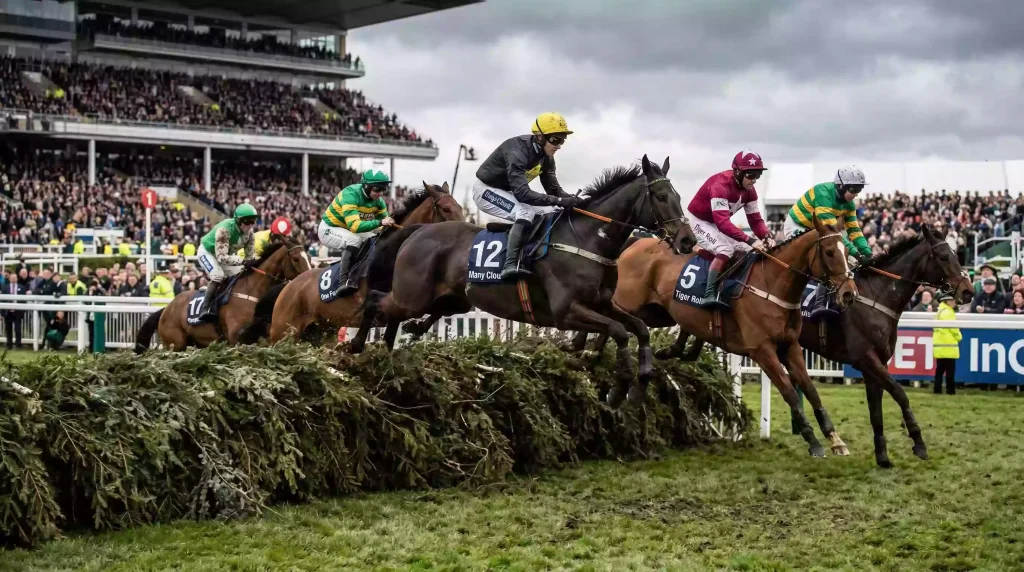
No single horse race generates more betting activity, more newspaper column inches, or more pub arguments than the Grand National. Run at Aintree Racecourse in Liverpool every April, this is the race that turns non-punters into once-a-year gamblers, that turns household names out of horses most people had never heard of the day before, and that produces Grand National results capable of rewriting ante-post markets for the following twelve months. It is also the race that has forced the sport to confront its most difficult questions about safety, welfare and the price of tradition.
The race matters commercially too. BHA Chief Executive Brant Dunshea stated that the Grand National alone generates approximately £60 million for the Liverpool City Region economy each year, supporting hundreds of jobs in hospitality, retail and transport. The result of the race ripples far beyond the racecourse.
Format and Recent Changes
The Grand National is a handicap steeplechase over a distance of approximately four miles and two-and-a-half furlongs, featuring 30 fences — 16 on the first circuit and 14 on the second. The course is unique: several of the obstacles are found nowhere else in British racing, including Becher’s Brook, The Chair, and the Canal Turn. The terrain is demanding. The distance is punishing. The field is the largest of any race in the calendar.
That field was reduced from 40 runners to 34 in 2026, one of a series of changes designed to improve safety. The first fence was moved further from the start to allow horses more time to settle into a rhythm. A standing start replaced the traditional flag start, reducing the pace at which horses approach the opening obstacles. Fence modifications — including the use of more flexible materials and altered profiles — have been implemented progressively over the past decade.
The race is also now timed earlier in the day than it once was, ensuring the best possible ground conditions. Aintree’s groundstaff work to deliver going that is safe without being either too firm or too testing, and starting the race before the afternoon sun dries out the turf is part of that calculation.
Prize money for the Grand National sits among the highest in British jump racing, though it is not the richest — the Cheltenham Gold Cup carries a larger purse. What makes the National exceptional is not its financial value but its cultural weight. An estimated 600 million viewers watch the race globally, and the UK’s licensed betting operators see more individual bets placed on this single race than on any other in the calendar.
Notable Winners and Records
The roll call of Grand National winners is part of British sporting folklore. Red Rum won the race three times — in 1973, 1974 and 1977 — a feat that has never been matched and probably never will be. His victory in 1977, at the age of 12, remains one of the most celebrated moments in racing history. Tiger Roll became the first horse since Red Rum to win consecutive Nationals, taking the race in 2018 and 2019 before the 2020 renewal was cancelled due to the pandemic.
The youngest jockey to win the Grand National was Bruce Hobbs, who rode Battleship to victory in 1938 at the age of 17. The oldest was Dick Saunders, who partnered Grittar to win in 1982 at 48. Rachael Blackmore made history of a different kind in 2021, becoming the first female jockey to win the race aboard Minella Times — a result that made front pages well beyond the racing press.
Winning margins tell their own stories. Neptune Collonges won by a nose in 2012, in one of the tightest Grand National finishes ever filmed. At the other extreme, horses like Aldaniti — whose victory in 1981 with Bob Champion, himself recovering from cancer treatment, became one of the most emotionally charged results in the sport’s history — won with authority in renewals where the narrative outweighed the margin. The distance of the race amplifies the unpredictability: over four miles and 30 fences, the best horse on paper is often not the one standing at the end.
The handicap system adds another layer. Every horse in the Grand National carries a weight determined by the BHA’s handicapper, and the spread from top weight to bottom weight can exceed 20 pounds. Results frequently show that horses carrying lighter weights — those lower in the handicap — outrun their more fancied rivals. The National rewards toughness, luck and a light weight as much as it rewards raw ability, and the results archive bears that out year after year.
Safety and Welfare Improvements
The Grand National’s relationship with horse safety is complicated and well-documented. There have been five fatal injuries from the last 10 runnings of the race, out of a combined total of 381 runners. Between 2013 and 2018, however, there were six consecutive Grand Nationals with no fatalities — proof that structural changes to the course can and do make a measurable difference.
The broader context is worth stating. The BHA recorded 158 equine fatalities from 87,619 starts across all British racing in 2023, a fatality rate of 0.18%. The Grand National, by virtue of its length, its field size and its obstacles, has always carried a higher risk profile than the average race. That is not a justification — it is a statistical reality that the sport’s regulators are actively working to reduce through the fence modifications, field reductions and veterinary protocols described above.
Every fatality at the Grand National undergoes an enhanced review protocol. Post-mortem examinations, video analysis from multiple angles, and interviews with connections are standard. The findings feed into ongoing research partnerships, including work with the Royal Veterinary College and the University of Exeter on obstacle visibility and equine vision. The race evolves because the evidence demands it.
How Grand National Results Impact Ante-Post Markets
The Grand National is the only British horse race with a year-round ante-post market. Bookmakers begin pricing horses for the following year’s renewal within days of the current one finishing. Early ante-post prices are speculative — they reflect a blend of handicap ratings, trainer intentions and historical precedent rather than any concrete form for the specific race.
Trial races during the winter months — the Becher Chase and Grand Sefton over the National fences in December, plus cross-country events at Cheltenham — provide the first tangible form indicators. Results from these trials reshuffle the ante-post market significantly. A horse that wins the Becher Chase will shorten from 33/1 to 16/1 overnight. A well-fancied contender that falls at the first in a trial may drift from 12/1 to 25/1.
For punters who study results seriously, the Grand National ante-post market is one of the most form-dependent in racing. The race has identifiable trends: recent winners tend to have run well over long distances on soft ground, tend to be aged between eight and eleven, and tend to have completed at least one full circuit of the National fences before. Results from specific preparatory races correlate with National performance more reliably than almost any other handicap pattern in British racing. The data is there. The challenge is reading it correctly.