
Horse Racing Abbreviations Guide — PU, F, UR, BD and More
 Available in US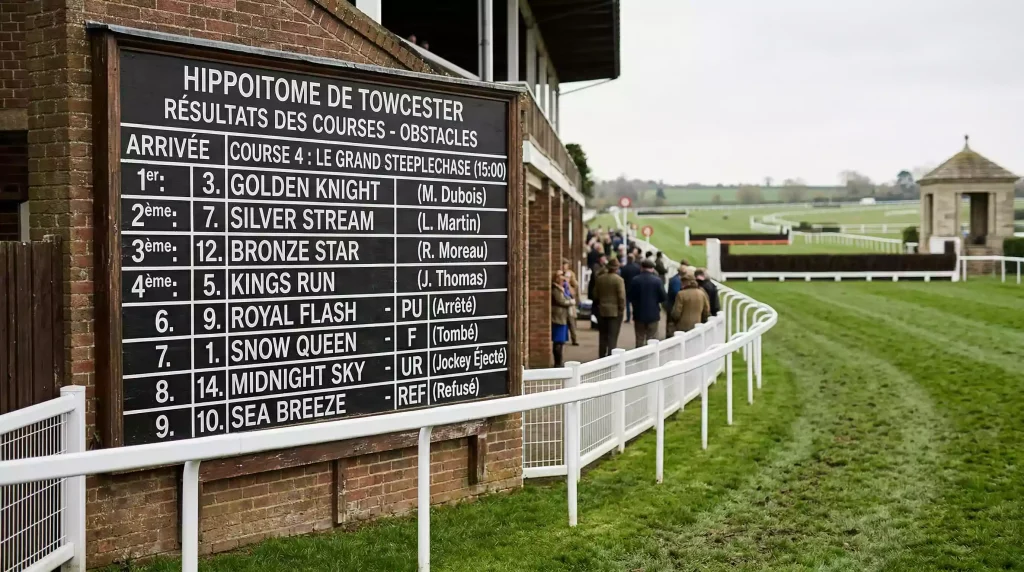
When a horse does not cross the finish line, the result does not leave a blank. It prints a letter — sometimes two — and that letter carries very specific meaning. PU. F. UR. BD. Each one explains what happened and, crucially, confirms that your bet on that horse is a loser. If you have ever scanned a result and seen a string of letters where you expected a number, this is the guide that unpacks every one of them.
Horse racing abbreviations are not optional knowledge for anyone who bets with any regularity. They appear in the finishing column of every set of results published in Britain, from the Racing Post to Sky Sports to the official BHA Stewards Reports archive. Jump racing produces these codes more frequently than the Flat, for obvious reasons — obstacles create opportunities for things to go wrong — but every code in the system can appear in either code of racing. What follows is the complete set, organised by what happened to the horse.
The numbers beside them are decoded in form figures.
Did Not Finish
PU — Pulled Up. The jockey made a conscious decision to stop riding and pull the horse up before the finish. This is typically a welfare decision. The horse may have been exhausted, injured, lame, or so far behind that continuing served no purpose. PU is the most common non-finishing abbreviation in jump racing. A single PU in a form string is not necessarily alarming — it might have been a precautionary measure on ground the horse hated. Multiple PUs in succession suggest a deeper issue with the horse’s fitness, soundness, or attitude.
F — Fell. The horse hit the ground during the race, usually at an obstacle. A fall is involuntary — the horse attempted the fence or hurdle and did not clear it. Falls vary in severity from a stumble on landing that brings the horse down to a crashing mistake at full speed. From a form perspective, F tells you the horse could not complete the race. It does not tell you whether the horse was going well at the time. A horse that fell at the last when three lengths clear was arguably running the best race of its life — the form figure just cannot show that.
The BHA recorded 158 equine fatalities from 87,619 starts in 2023, a fatality rate of 0.18%. Not all of these resulted from falls — some were sudden cardiac events or other causes — but falls remain the primary risk event in jump racing, and the F code in a result is the statistical front line of that reality.
UR — Unseated Rider. The horse made a mistake and the jockey was displaced, but the horse itself did not fall. The horse stayed upright; the rider did not. This is a meaningful distinction. A horse with a U in its form may be a perfectly capable jumper that had one uncharacteristic lapse. A horse with repeated Us at the same fence type — say, ditched fences — may have a specific jumping weakness.
BD — Brought Down. The horse was brought to a halt or brought to the ground by another horse’s fall. This is the innocent-bystander code. The horse did nothing wrong; it was in the wrong place when a rival fell in front of it or across its path. From a form assessment standpoint, BD should be treated with sympathy. The horse may well have been travelling powerfully at the time, and its race was ended by someone else’s mistake.
RO — Ran Out. The horse left the racecourse during the race, usually by ducking out to one side at a fence. This is a voluntary exit — the horse chose not to jump and went around the obstacle instead. It often indicates a loss of confidence or a dislike of a particular fence type.
SU — Slipped Up. The horse lost its footing, usually on the Flat or on a bend. Slipping up is ground-related — wet turf, a tight turn on soft going — rather than obstacle-related. It is rare enough that seeing SU in a form string is noteworthy.
CO — Carried Out. The horse was forced off the track by another horse’s movement. Similar to BD, this is not the horse’s fault. It was carried wide or off the course by interference.
Disqualifications and Amendments
DSQ — Disqualified. The horse finished the race but was subsequently removed from the placings. Disqualification can result from a stewards’ enquiry finding interference, a failed drug test, or a weight discrepancy discovered at the scales. A DSQ in the result means the horse completed the course but was stripped of its finishing position. For bettors, the treatment depends on the bookmaker — some pay first past the post, some settle on the official result, and an increasing number pay both.
The BHA’s Disciplinary Panel, restructured in 2017, handles appeals against disqualification decisions. As the BHA’s own Director of Regulation has acknowledged, the majority of appeals to the independent Panel since that restructuring have been successful, with suspensions overturned in most cases. This does not mean disqualifications are routinely wrong — it means the appeals process is rigorous and the Panel demands a high evidential bar.
VOI — Void. The race itself was declared void, meaning no official result exists. This is extremely rare — it might happen if the start was so chaotic that no fair race took place, or if conditions rendered the race unsafe after it had begun. A void race means all bets are returned as stakes. The VOI code effectively erases the race from the record.
Other Codes
RR — Refused to Race. The horse declined to participate. It planted its feet at the start and would not move, or it turned around and walked back to the stables. RR appears rarely but is memorable when it does — it is the equine equivalent of a no-show. For betting purposes, a horse that refused to race is a loser unless it was officially declared a non-runner before the off, in which case your stake is returned.
LFT — Left at Start. The horse was left standing when the field broke away. The stalls opened (or the tape went up) and the horse did not go with the rest. This can happen because of a stumble, a moment of inattention, or a refusal to break cleanly. LFT is different from RR because the horse was at the start and the race began — it just did not go with it.
NR — Non-Runner. Strictly speaking, NR is not a result abbreviation because the horse never ran. But it appears in racecards alongside horses that were declared but subsequently withdrawn before the off. NR affects bets through Rule 4 deductions (a reduction to your payout to account for the withdrawn horse’s chance) and can alter field sizes, which in turn affect place terms for each-way bets.
How Abbreviations Appear in Results Tables
In a standard UK results table, the finishing column shows a number for every horse that completed the race and a letter code for every horse that did not. The convention is consistent across platforms: the placed horses appear first (1st, 2nd, 3rd, 4th), followed by the remaining finishers in order, followed by the non-completers grouped by their code.
A typical finishing column for a 12-runner steeplechase might look like this: 1, 2, 3, 4, 5, 6, 7, PU, PU, F, UR, BD. That tells you seven horses finished, two were pulled up, one fell, one unseated its rider, and one was brought down. The order of the non-completers sometimes indicates when they exited — a horse listed as PU before another PU may have pulled up earlier in the race — but this is not always consistent across platforms.
On Racing Post, the abbreviation appears in the position column with a brief note in the in-running comments explaining the circumstances. On the BHA’s Stewards Reports page, the code is accompanied by any regulatory action taken — for example, a jockey fined for pulling up too early, or a trainer interviewed about a horse that refused. These supplementary notes are not part of the abbreviation itself, but they sit alongside it in the full result and can provide critical context for form study.
The key takeaway is that every letter in a racing result is precise. There is no ambiguity between F and U, between PU and RR, or between BD and CO. Each code describes a specific event, and each event has specific consequences — for the horse’s form record, for your bet, and for the regulatory scrutiny that follows. When you see a letter where you expected a number, you are not looking at a glitch. You are looking at a story.
Created by the "UK Horse Racing Results" editorial team. The wider context is set out in today's UK horse racing results.
