
Horse Racing Going and Ground Conditions Explained
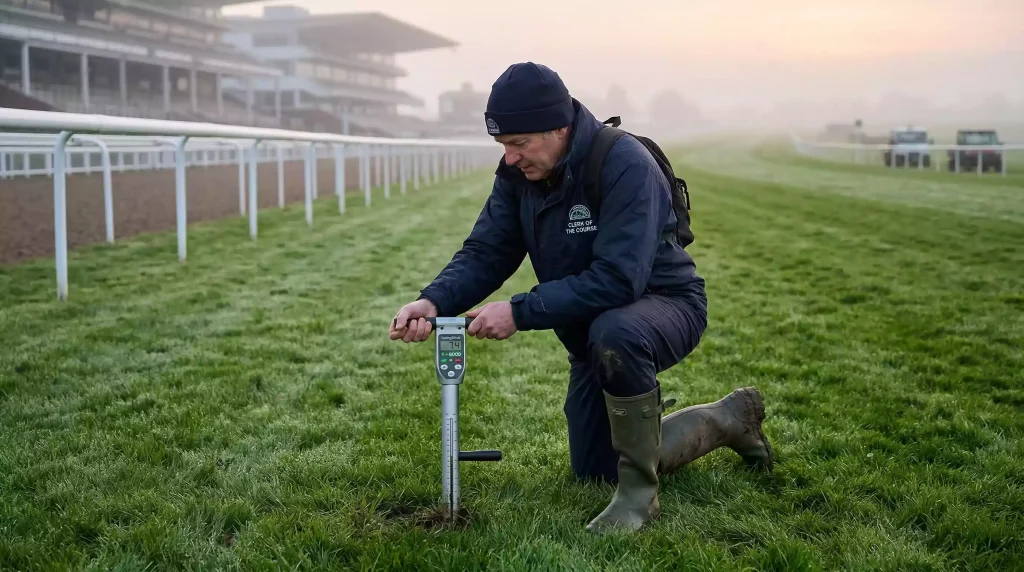
No single variable affects horse racing results more profoundly than the going. The state of the ground — firm or soft, fast or heavy — determines which horses will thrive, which will struggle, and which will be withdrawn before the race even begins. A horse that cruised to victory on good ground last month might finish tailed off on heavy going today, not because it has lost ability but because the ground beneath its hooves has changed completely. Horse racing going explained in practical terms is the difference between reading results at face value and reading them with context.
The going is assessed and published by the clerk of the course at each racecourse, using a combination of physical inspection and a tool called the GoingStick — a penetrometer that measures the resistance and cushioning of the turf. The official going description appears in every racecard and every result, and it is the single most important piece of contextual information attached to any set of finishing positions. According to BHA Racing Statistics, this data is updated throughout each raceday and published as part of the sport’s transparency commitments.
The Going Scale
British racing uses a standardised scale of going descriptions, running from the fastest (driest) surface to the slowest (wettest). The full scale, from firm to heavy, applies to turf racing. All-weather surfaces use a separate, simpler designation — typically “standard” or “standard to slow” — because synthetic tracks are less affected by weather.
On turf, the scale runs as follows: Hard, Firm, Good to Firm, Good, Good to Soft, Soft, Heavy. “Hard” ground is baked dry and rarely seen in Britain — it tends to occur only during extreme summer heatwaves and is considered risky for horse welfare. “Firm” is fast and dry, favouring speed horses. “Good to Firm” is the preferred going for most Flat racing — quick enough for pace but with some give in the ground. “Good” is the baseline — neither particularly quick nor testing.
Moving down the scale, “Good to Soft” introduces significant moisture. Horses that act on it tend to be those with a longer stride and more stamina. “Soft” ground is heavy and energy-sapping — races take noticeably longer, and the gaps between horses tend to widen. “Heavy” is the extreme: a thick, clinging surface that demands enormous stamina and can stop horses with suspect jumping or limited reserves of energy. In the 2026 jump season, 78% of fixtures in the first three months were run on soft or heavy ground compared with a three-year average of 48%, directly affecting field sizes and form patterns.
The GoingStick provides a numerical reading on a scale from 1.0 to 15.0. Lower numbers indicate softer ground; higher numbers indicate firmer. A reading of around 5.0 to 7.0 typically equates to “Good to Soft” or “Good.” Below 5.0 is “Soft” or “Heavy.” Above 9.0 is “Good to Firm” or “Firm.” In practice, most readings fall between roughly 4.5 and 12.0, with extremes above 10.0 very uncommon in the UK. The clerk of the course uses the GoingStick reading alongside their own walking inspection and local knowledge to arrive at the official going description. It is not a purely mechanical process — judgement is involved.
How Going Affects Performance
Different horses have different ground preferences, and those preferences are often visible in their results. A sprinter bred for speed — compact, muscular, with a quick action — will typically produce its best results on firm or good-to-firm ground, where it can maintain its top speed without the surface dragging at its stride. A staying chaser with a big, galloping frame may relish soft or heavy ground, where its stamina advantage is amplified and its rivals’ speed is neutralised.
Breeding plays a significant role. Certain stallions consistently sire offspring that handle soft ground better than firm, and vice versa. Trainers and form analysts track these sire statistics carefully. A horse by a known soft-ground sire, running for the first time on heavy going, may be worth a second look even if its previous results were moderate on firmer surfaces.
Jump racing is more sensitive to going changes than the Flat, partly because of the longer distances involved and partly because the obstacles add a dimension of risk that increases on softer ground. A horse jumping a birch fence on heavy going must contend with take-off ground that gives way underfoot, a landing area that absorbs impact unevenly, and a surface that demands more effort between fences. The average field size over jumps in 2026 — 7.84 runners per race, compared with 8.90 on the Flat — reflects, in part, the attrition caused by unsuitable going conditions throughout the winter season.
Going Changes During the Day
The going is not static. It can change during a meeting due to rainfall, drying winds, or deliberate watering by the groundstaff. A course that opens as “Good to Firm” in the morning may be reclassified as “Good” by the fourth race if a shower passes through. These changes are published by the course and relayed to betting platforms, but they can catch bettors off guard if they placed bets based on the morning assessment.
Watering is a routine practice on Flat courses during the summer. Clerks of the course water to maintain safe, consistent going and to prevent the ground becoming excessively firm. The amount of water applied varies by course and conditions, and it is publicly disclosed. A course that reports “7mm of water applied overnight” is telling you that the going is being managed downwards — from firmer towards good.
Going updates during a meeting typically coincide with the post-race assessment between each race. The clerk walks the course, takes GoingStick readings, and may amend the official going between races. These amendments are announced on course and online. In Q1 2026, 87.6% of British races started within two minutes of their scheduled off-time — an improvement driven partly by better coordination between going assessments and race scheduling, which reduces the delays caused by late going changes.
Reading Going in Results Context
Every result carries a going description. It appears alongside the course name, date, distance and race conditions at the top of the result card. When analysing form, the going description is the first thing to check — before the finishing positions, before the SP, before the distances.
A horse that won on soft ground has not necessarily demonstrated the same level of ability as one that won on good ground. Soft-ground races tend to be slower, more attritional, and more likely to produce non-completions over jumps. The winning time on soft ground will be longer than the standard time for the course and distance, which means speed figures will be adjusted downwards. Conversely, a horse that won on firm ground in a fast time will receive a higher speed figure — but may not reproduce that form on different going.
The practical discipline is straightforward: always note the going when recording a horse’s result. Over time, you will build a picture of each horse’s ground preferences that is far more reliable than any single result taken in isolation. A horse with form figures of 1-3-1-2-5 looks inconsistent at first glance. But if you overlay the going — won on soft, third on good, won on soft, second on good to soft, fifth on firm — the pattern is obvious. The horse wants give in the ground. When it gets it, it wins. When it does not, it labours. The going is the explanation that the bare result does not provide.