
Horse Racing Non-Runners Today — Rules and Betting Impact
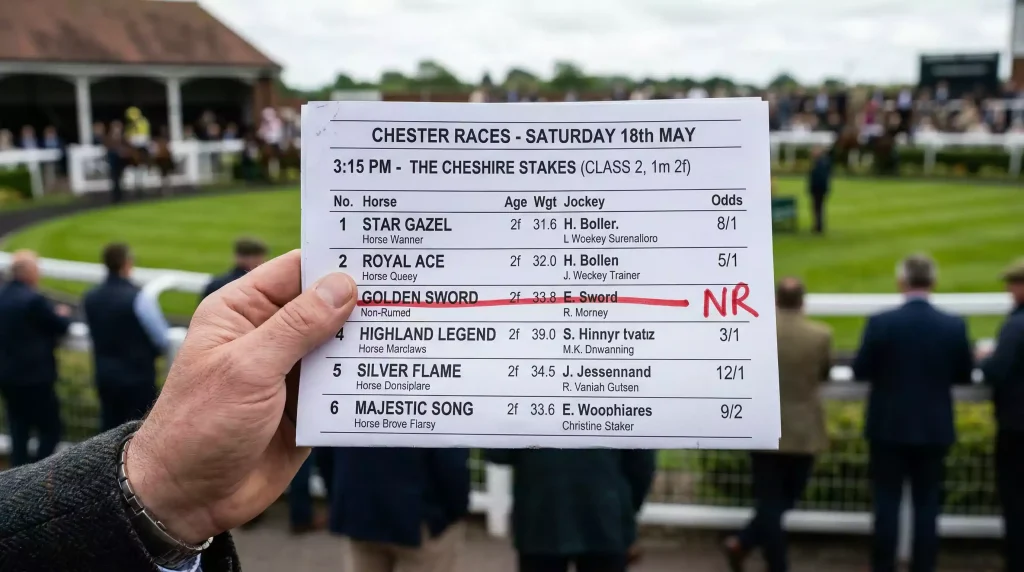
A non-runner in horse racing is a horse that was declared to run but was withdrawn before the race started. The entry appeared on the racecard, the markets priced it in, bets were placed on it — and then it did not run. For punters, a non-runner triggers a chain of consequences: refunded stakes, Rule 4 deductions on remaining bets, altered field sizes, and in some cases, fundamentally different race dynamics. Non-runners today are not an edge case. They happen at virtually every meeting, and understanding the rules around them is essential for anyone who bets with any regularity.
The scale of the horse population gives context to how frequently this occurs. The BHA’s 2026 Racing Report recorded 21,728 horses in training — a 2.3% decline from the previous year, continuing a multi-year downward trend. Fewer horses in training means tighter margins in the race programme, and when declarations are already stretched, even one or two withdrawals per race can shift the competitive balance meaningfully.
Why Horses Are Withdrawn
The reasons for a non-runner fall into several broad categories, and the timing of the withdrawal determines how it affects your bet. The most common cause is unsuitable going. A horse entered to run on good ground may be withdrawn if overnight rain turns the track soft. Trainers make this call in the horse’s best interest — running on ground the horse dislikes risks injury and poor performance — but it means the racecard you studied the night before no longer reflects the actual field.
Veterinary inspection is another frequent trigger. Every horse declared to run must pass a pre-race veterinary check at the course. If a horse shows signs of lameness, respiratory distress or any other condition that raises welfare concerns, the racecourse veterinary officer can order its withdrawal. These inspections happen on the morning of the race, giving connections little time to find a replacement plan.
Injury in the days between declaration and raceday accounts for a further tranche of non-runners. A horse might work well on Tuesday morning, be declared for Thursday’s race, and then pull a muscle on Wednesday. The trainer withdraws, and the non-runner notice is published. Owner or trainer decisions — a change of plan to run at a different meeting, a strategic decision to wait for better conditions — round out the picture.
Finally, there are late withdrawals at the start. A horse that refuses to load into the stalls, or that becomes unruly at the tape, can be withdrawn by the starter. These are rare but dramatic, and they create particular complications for bettors because they occur after the market has closed.
Rule 4 Deductions Explained
When a horse is withdrawn after the final declaration stage — the point at which the market is considered fixed — Rule 4 of the Rules of Racing comes into effect. Named after the relevant rule in the Tattersalls Committee regulations, Rule 4 authorises a deduction from the winnings of all bets on the race to account for the withdrawn horse’s chance. The logic is that the remaining horses are now more likely to win because the competition has reduced, and the odds you took no longer reflect the true probability.
The deduction is scaled to the withdrawn horse’s price at the time of withdrawal. The shorter the price, the larger the deduction. A withdrawn 1/1 favourite triggers a deduction of 45 pence in the pound. A withdrawn 10/1 shot triggers a deduction of just 5 pence. The full scale runs from 90 pence (for a horse priced at 1/10 or shorter) down to zero (for horses at 14/1 or longer, where the withdrawal is deemed to have negligible impact on the market).
In practice, Rule 4 reduces your returns even when your horse wins. If you backed a 4/1 winner with a Rule 4 deduction of 25 pence in the pound, your profit is 75% of what it would have been without the deduction. On a £10 bet, that is a return of £40 instead of £50 — still a winner, but measurably less rewarding. For accumulator bettors, Rule 4 compounds through the legs: each deduction reduces the rolled-over amount, shrinking the final payout disproportionately.
The gross gambling yield from remote horse racing betting in 2026/25 was £766.7 million. A meaningful portion of those returns was subject to Rule 4 deductions, given the daily frequency of non-runners across British racing. The deduction system is not a penalty on the bettor — it is a correction mechanism that keeps the market honest when the conditions under which bets were placed have changed.
Impact on Field Size and Results
Non-runners reduce the field, and a reduced field changes the race. A 12-runner handicap with two non-runners is a 10-runner handicap. The pace may differ, the tactical dynamics shift, and the draw — which is assigned based on the original declarations — may become less or more significant depending on which stalls are now empty.
For each-way bettors, the impact is immediate. If the field drops below eight runners because of non-runners, the number of each-way places may reduce from three to two. Your bet was placed on the assumption of three places, and now it covers only two. Most bookmakers honour the place terms that applied at the time the bet was struck, but this is a matter of individual operator policy, not regulation. Check the terms before assuming.
From a form-study perspective, non-runners from previous races can distort how you read the results. A horse that won a race with three non-runners effectively beat a weaker field than the racecard suggested. The result says “1st of 9” but the reality might be “1st of 9, minus the two best-fancied runners.” The stewards’ report will note the non-runners, and the full result will show the adjusted field size, but you need to look for it deliberately.
Where to Check Non-Runners
Non-runner information is published through multiple channels. The BHA’s official going and non-runners page — accessible via its website — lists all withdrawals by course and race, with the reason for each one. Racing Post updates its racecards in real time, with NR displayed next to withdrawn horses and the original field size adjusted. At The Races and Sporting Life follow the same model.
Bookmaker apps are often the fastest channel. Most licensed operators push non-runner notifications to customers who have placed bets on the affected race. If you backed a horse at 8am and it is withdrawn at 10am, you will typically receive an alert within minutes, along with confirmation that your stake has been refunded (for the non-runner itself) or that a Rule 4 deduction has been applied (for bets on other horses in the race).
For those at the racecourse, non-runner announcements are made over the public address system and displayed on course screens. The bookmakers’ boards in the ring will also remove the non-runner’s price and note any Rule 4 deductions. Between the digital and physical channels, there is no excuse for being caught unaware by a non-runner — provided you are paying attention.