
Horse Racing Speed Ratings Explained
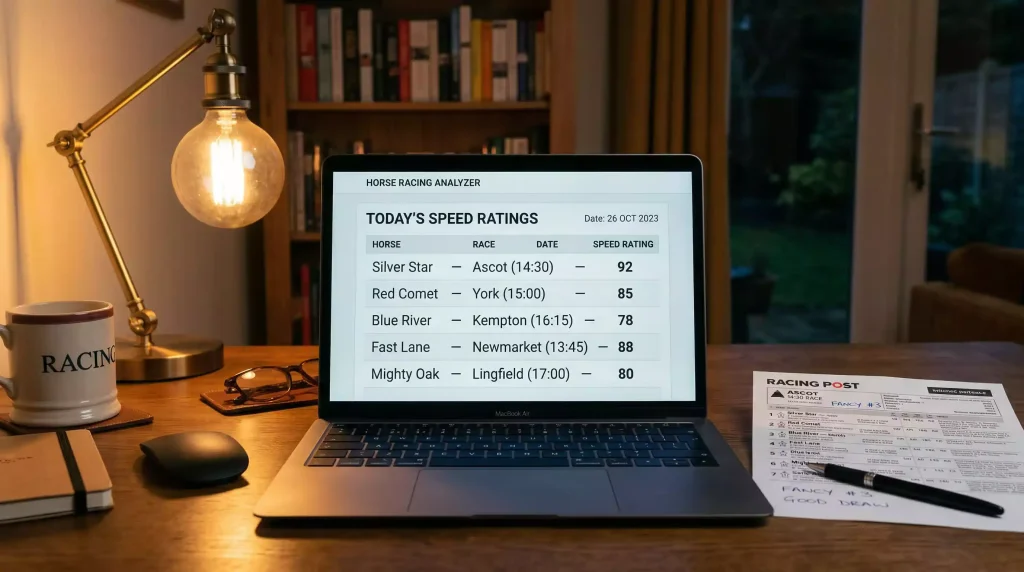
A horse wins by three lengths at Newmarket on good ground. Another horse wins by three lengths at Haydock on soft. Which performance was better? The result alone cannot tell you — the courses are different, the ground is different, the race class may be different. Horse racing speed ratings exist to answer exactly this question. They convert the raw time of a race into a standardised figure that allows meaningful comparison across courses, going conditions, distances and dates. Without them, you are comparing finishing positions in a vacuum.
Speed ratings are not new — Timeform has been producing them since the 1940s — but their availability and sophistication have increased dramatically in the digital age. Multiple providers now publish ratings for every runner in every race, accessible to anyone willing to look beyond the bare result. Understanding how these ratings are calculated, who produces them, and how to use them alongside results is one of the more technically rewarding skills in form study.
How Speed Ratings Are Calculated
The basic principle is straightforward. Every racecourse has a standard time for each distance — the time a race of that class should take on good ground. The actual time of the race is compared to the standard time. If the race was faster than standard, the speed figure is adjusted upwards. If it was slower, it is adjusted downwards.
The crucial variable is the going adjustment. A race run on heavy ground will be slower than standard, but that does not mean the horses ran poorly — it means the surface was demanding. The going adjustment removes this distortion, estimating how much slower the race would be expected to run given the ground conditions, and crediting the horses accordingly. A horse that runs two seconds slower than standard on heavy going might receive a speed figure equivalent to one that ran exactly to standard on good ground, because the going adjustment accounts for the difference.
Weight adjustments add another layer. In handicap races, horses carry different weights, and a horse carrying more weight has to work harder to achieve the same time. Some rating systems apply a weight-for-age or weight-carried adjustment to the speed figure. Others — notably the BHA’s own performance figures — incorporate weight into the raw rating, producing a single number that reflects both speed and the burden under which it was achieved.
The average field size in British Flat racing in 2026 was 8.90 runners per race. In a field of nine, the speed figure of the winner is useful, but so are the figures for the second and third — and even the horses that finished further back. A horse that recorded a high speed figure in defeat may have run faster than many winners at the same course that week. The figure, not the finishing position, tells you how much ability was on display.
Major Rating Providers
Timeform is the oldest and most respected commercial rating service in British racing. Founded in 1948, it assigns a numerical rating to every horse based on its performances, with ratings calibrated on an absolute scale. A Timeform rating of 140 over jumps or 120 on the Flat denotes a genuinely high-class performer. Timeform ratings are available to subscribers through the Timeform website and integrated into its Race Pass product, where they sit alongside in-running comments, form data and pre-race analysis.
Racing Post Ratings (RPR) are the equivalent product from Racing Post. RPR figures appear on every racecard and result page on the Racing Post platform. They operate on a similar scale to Timeform but are calculated independently, using Racing Post’s own methodology. For many punters, RPR is the first rating they encounter and the one they use most frequently, simply because Racing Post is the most widely used racing platform in the UK.
The BHA Performance Figures are the official ratings produced by the British Horseracing Authority’s handicapping team. These are the figures used to assign weights in handicap races. The BHA publishes thresholds — a performance figure of 85 or above on the Flat, and 135 or above over jumps — to identify high-quality performers. These thresholds are used internally to track the sport’s competitive health. In 2026, the number of horses achieving 90+ on the Flat increased to 1,423, up from 1,398 the previous year, while over jumps the number of 135+ performers stabilised at 489 after significant declines in recent years.
Proform Racing takes a different approach, using statistical simulation to produce its Power Ratings. Rather than relying solely on time-based analysis, Proform runs thousands of database queries against seven race factors for each horse, producing a forecast probability that is then expressed as an odds-equivalent rating. The provider claims its top-three Power-rated horse wins approximately 60% of the time — a useful benchmark for assessing its accuracy.
BHA 85+ and 135+ Thresholds
The BHA’s performance figure thresholds serve a dual purpose. Internally, they measure the sport’s ability to attract and develop quality horses. Externally, they provide a reference point for form students who want to know whether a horse is operating at a level above the ordinary.
The horse population in Britain has been declining — 21,728 horses in training in 2026, a fall of 2.3% from the previous year, continuing a multi-year trend. In that context, the stability of the 135+ jumps population at 489 and the growth of the 85+ Flat population to 1,423 are cautiously positive signals. They suggest that while the overall horse population is shrinking, the quality at the top end is being maintained — and in the case of the Flat, marginally improving.
For the results consumer, the practical implication is this: a horse with a BHA performance figure above these thresholds is competing at a level where speed ratings become highly discriminating. The difference between a 90-rated horse and a 95-rated horse may seem small, but over a mile on the Flat it translates to a length or more at the finish. In results, that gap is the difference between winning and finishing fourth.
How to Use Ratings Alongside Results
Speed ratings are most useful when applied to a specific question. Rather than scanning every horse’s rating in a 12-runner handicap, focus on the question the racecard raises: is the favourite justified? The speed figure of the favourite’s most recent run, compared to the best recent figures of its rivals, gives you a data-driven answer. If the favourite’s best speed figure is 85 and the second-highest figure in the field is 78, the market is probably right. If three horses share similar figures in the low 80s, the race is more competitive than the prices suggest.
Improving speed figures are a stronger signal than peak figures. A horse whose last three ratings read 72, 76, 80 is on an upward curve — the kind of trajectory that wins races, especially if the horse is moving into a class where the average winning figure is around 80. A horse with a peak figure of 90 but recent figures of 75, 72, 70 is in decline, and backing it on reputation rather than evidence is a well-worn path to loss.
The result tells you who crossed the line first. The speed rating tells you how fast they did it, adjusted for everything the raw time cannot capture. Used together, they provide a far more accurate picture of what happened in a race — and a far more reliable foundation for predicting what will happen next.