
Horse Welfare in British Racing — Safety Data and Protocols
 Available in US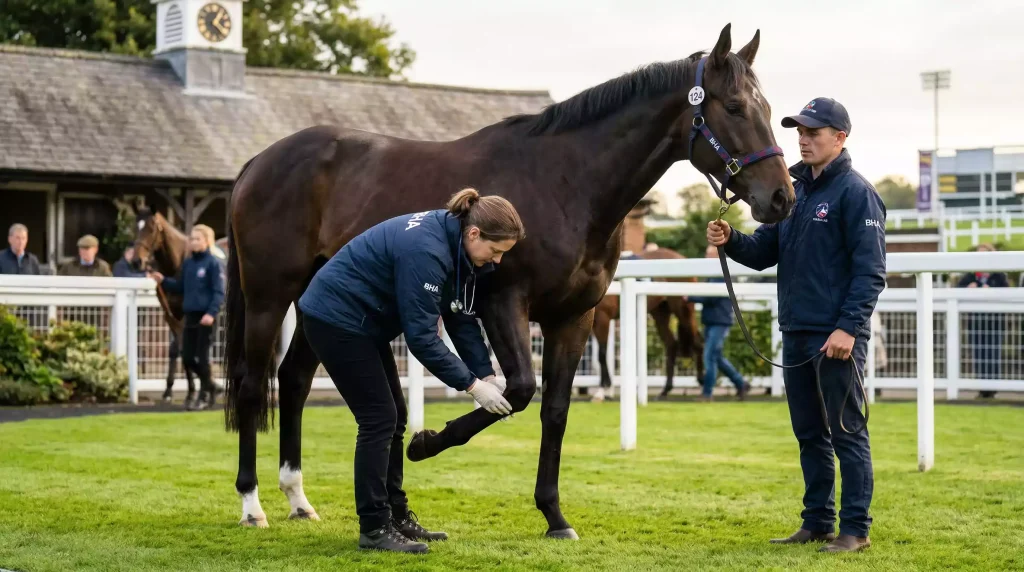
Horse welfare in British racing sits at the point where results, regulation and public opinion converge. Every non-completion in a race result — every PU, every F, every UR — represents a moment where something went wrong for the horse. Some of those moments are minor. Others are catastrophic. The sport’s ability to minimise the catastrophic ones, measure them transparently, and demonstrate continuous improvement is what sustains its social licence to operate in an era of growing public scrutiny.
The BHA has invested substantially in this area. According to a press release accompanying the review of fatalities at the 2026 Cheltenham Festival, British racing has channelled £56 million into equine health, veterinary science and research since the year 2000. That figure funds everything from the Racing Risk Models developed with the Royal Veterinary College to AI-based tests for detecting irregular heart rhythms in racehorses. The investment is real. The question is whether it is enough.
The regulator's side of it is in gambling regulation.
Fatality Rates and Definitions
The BHA’s primary welfare metric is the equine fatality rate — the number of horses that die as a direct result of racing, expressed as a percentage of total starts. In 2023, the BHA recorded 158 fatalities from 87,619 starts, a rate of 0.18%. In 2022, the figure was 169 from 86,419 starts, or 0.20%. The five-year rolling average stood at 0.20%, and the trend — viewed over a decade — shows a gradual downward trajectory. These are not comfortable numbers for anyone who cares about animals, but they are measurably lower than they were ten or twenty years ago.
Jump racing accounts for the majority of fatalities. In 2023, 112 of the 158 deaths occurred over jumps — a rate of 0.37% of jump starts, the joint-lowest this century. On the Flat, fatalities are substantially rarer, driven primarily by sudden cardiac events and musculoskeletal failures rather than obstacle-related incidents.
The definition itself has evolved. From 2026, the BHA expanded the definition of a raceday fatality to include all horses euthanised within 48 hours of a raceday incident, regardless of whether the euthanasia was a direct consequence of the injury sustained during racing. This expanded definition — which captures so-called “elective euthanasia,” where a horse is put down for welfare reasons even if it could theoretically survive — represents a more honest accounting of the sport’s impact on the animals involved. The numbers under the new definition will be higher than under the old one, not because more horses are dying but because more deaths are being counted.
BHA Safety Investments
The £56 million invested since 2000 has funded a range of initiatives. The Racing Risk Models, developed in partnership with the Royal Veterinary College, use 14 years of accumulated data to identify the risk factors associated with falls, injuries and fatalities. These models draw on information about horse demographics, race conditions, course characteristics, and trainer and jockey experience to flag races and runners that carry elevated risk profiles. The output feeds into race planning, course inspection and veterinary protocols.
A separate research programme, funded by the HBLB, is developing an AI-based test to identify horses at risk of developing irregular heart rhythms — a known precursor to sudden death during racing. The project, nearing completion, involves collaboration between veterinary specialist Celia Marr, the University of Surrey’s Faculty of Health and Medical Sciences, and international partners. If successful, the test could allow pre-race screening that removes at-risk horses from competition before the problem manifests on the track.
Obstacle modification has been one of the more tangible safety measures. Research into equine vision, commissioned by the BHA and conducted by the University of Exeter, led to changes in fence construction designed to improve obstacle visibility for horses at speed. The Grand National fences have been progressively modified — with more flexible materials, adjusted profiles, and repositioned first fences — based on this research. The 2026 changes to the Grand National, including reducing the field from 40 to 34 runners and introducing a standing start, were directly informed by safety data.
Every fatality triggers a formal review protocol. Post-mortem examinations, video analysis from multiple camera angles, and interviews with the horse’s connections are standard procedure. The findings feed back into the risk models, creating a feedback loop between individual incidents and systemic improvements.
Aftercare and Traceability
The sport’s responsibility to horses does not end at the racecourse. The 2023 Thoroughbred Census — a comprehensive survey of the post-racing population — found that over 80% of British thoroughbreds that have been retired from racing are active and identifiable. This means the sport can account for the majority of its former athletes, tracking them through second careers in eventing, polo, riding schools and leisure ownership.
National Racehorse Week, held every September, opens studs, training yards and aftercare centres across the country to the public. Over 50,000 people have attended events during the initiative’s first four years. The aim is transparency: showing the public what life looks like for horses in training and after retirement, and addressing misconceptions about how the sport treats its animals.
Traceability remains imperfect. The 80% figure means that 20% of retired thoroughbreds are not accounted for through the census process. Some of those will be in private hands with no connection to racing. Others may have been exported. A small number — the BHA reports three British-trained horses put down at a GB abattoir in 2026 — reach the end of the welfare chain entirely. The sport is open about these numbers. Whether the public considers them acceptable is a separate question.
Public Perception and Social Licence
Public attitudes towards horse welfare in racing have shifted perceptibly over the past decade. High-profile incidents — multiple fatalities at a single meeting, televised falls during the Grand National, investigative journalism exposing abattoir practices — generate media coverage that reaches audiences far beyond the sport’s core fanbase. The BHA’s response has been the HorsePWR campaign, launched in partnership with Great British Racing, which proactively publishes welfare data, safety investments and aftercare statistics in a format designed for a general audience.
As BHA Chief Executive Brant Dunshea has noted, the racing industry supports 85,000 jobs across Britain, from stable staff and jockeys to caterers and groundstaff. The economic argument for racing’s continued existence is substantial. But that argument carries weight only as long as the public believes the sport treats its horses responsibly. Welfare data, published transparently and backed by visible investment, is the industry’s primary tool for maintaining that belief.
The tension is permanent. Racing involves risk. Horses will always fall, sustain injuries, and — in a small percentage of cases — lose their lives. What the welfare framework aims to achieve is not the elimination of risk but its minimisation, measured transparently, with every incident reviewed and every available lesson applied. The fatality rate in the result is a number. The system behind that number is what determines whether the sport deserves to continue producing results at all.
Created by the "UK Horse Racing Results" editorial team. The wider context is set out in today's UK horse racing results.
