
How to Read a Racecard — Runners and Riders Explained
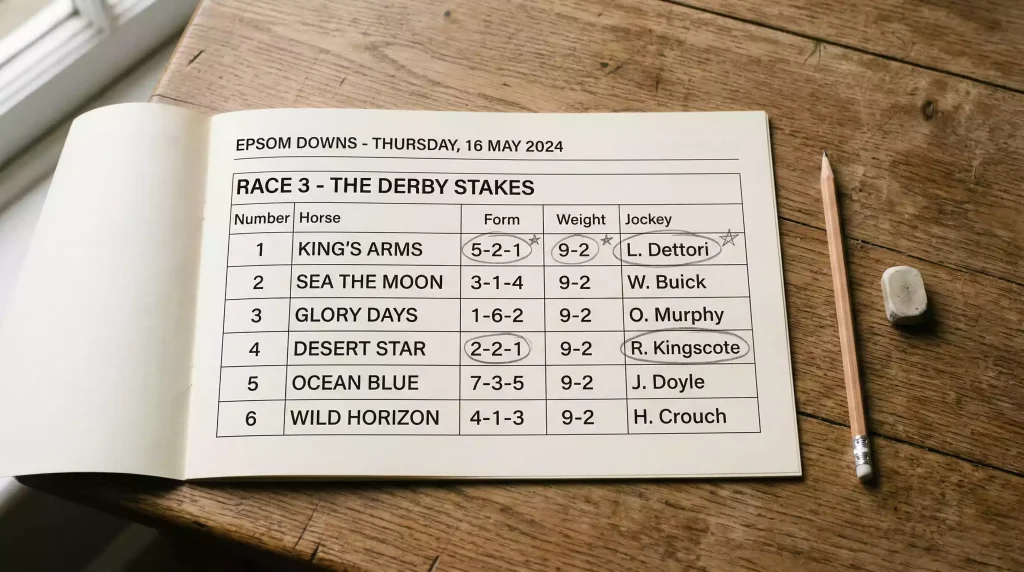
The racecard is what you study before the race. The result is what you study after it. Learning to read a racecard means understanding the raw material from which results are made — the declared runners, their form, their weight, their draw, the jockey booked to ride them, and the trainer responsible for their preparation. Every one of these data points appears in the result too, but the racecard gives them to you in advance, when you can still act on them.
Britain stages approximately 1,460 fixture days per year, each producing between five and eight races. Every race generates a racecard — a structured document listing all declared runners and the key information attached to each one. Whether you are studying it on a phone screen, a printed card at the track, or a premium digital platform, the layout follows a consistent logic. Once you decode that logic, you can assess a field in under a minute.
Racecard Sections Decoded
The racecard for a typical race contains the following data for each horse, usually arranged in columns. The order and formatting vary by platform, but the content is standardised.
Cloth number and draw. The cloth number is the number displayed on the horse’s saddlecloth — it is how you identify the horse on the course and in live coverage. The draw, shown as a number in brackets next to the cloth number on Flat races, indicates which stall the horse starts from. On some courses, a low draw (near the inside rail) is advantageous; on others, a high draw is preferred. Over jumps, there is no draw because horses start from a tape or flag.
Horse name and age. The horse’s registered name, followed by its age. On the Flat, most runners are between two and five years old. Over jumps, the typical age range is five to twelve. Age tells you something about the horse’s stage of development — a two-year-old is a novice; a seven-year-old jumper is in its prime.
Weight. The weight the horse carries, expressed in stones and pounds. Handicap races assign different weights based on the BHA handicapper’s assessment of each horse’s ability. The better the horse, the more weight it carries. In non-handicap races, weight is determined by the race conditions — typically based on age and sex.
Headgear. Symbols or abbreviations indicating any equipment the horse wears — blinkers (b), a visor (v), cheekpieces (cp), a tongue tie (t), a hood (h). First-time headgear is often flagged separately because it can signal a change of tactics by the trainer. A horse wearing blinkers for the first time may be expected to race more prominently.
Form figures. The horse’s finishing positions in its most recent races, displayed as a compact string of numbers and letters. This is the same form figure that appears in the result after the race, updated with the latest finishing position. The racecard shows form up to the point of the current race.
Jockey and trainer. The name of the jockey booked to ride and the trainer responsible for the horse’s preparation. Top jockeys are often booked by multiple trainers, so the jockey-trainer combination can indicate the level of expectation. A leading trainer putting a top jockey on a horse in a moderate handicap is worth noting.
Forecast odds. An estimated price for each horse, published by the racecard provider based on market intelligence. This is not the SP — it is a pre-race estimate that will shift as money comes in. On Racing Post cards, the forecast price is labelled as such and sits alongside the option to back the horse at current bookmaker prices.
Connecting Racecard to Results
Some racecard data carries directly into the result. The finishing position replaces the forecast price. The SP replaces the estimated odds. The in-running comments replace the pre-race analysis. Weight, jockey and trainer remain the same (unless there is a late jockey change, which is noted in both the card and the result).
The most important connection is between form figures and the result. The form string on the racecard tells you how the horse has performed recently. The result of today’s race adds one new digit — or letter — to that string. If you studied the card and backed a horse showing form of 1-21, and it finishes second today, the updated form becomes 1-212. Tomorrow’s racecard, if the horse runs again, will show that updated sequence.
Where the racecard and result diverge most sharply is on price. The forecast odds on the card are speculative; the SP in the result is final. A horse priced at 8/1 on the morning racecard may return an SP of 5/1 if it attracts heavy support. The racecard price is a guide. The result price is a fact.
Digital vs Print Racecards
Print racecards — the folded sheets sold at the racecourse or published in the Racing Post newspaper — are static snapshots. They reflect the state of declarations at the time of printing, typically the evening before the meeting. Non-runners declared on the morning of the race will not appear on the printed card, and late jockey changes may not be reflected. For racegoers, the number board at the course — updated live — fills in these gaps.
Digital racecards update in real time. Racing Post, Timeform and At The Races all offer interactive cards that reflect non-runners, jockey changes and going updates as they happen. Premium subscriptions — Timeform Race Passes, Racing Post Members’ Club — add analytical layers: speed ratings, performance figures, analyst verdicts and predicted finishing positions. With over five million people attending British racecourses in 2026, many of them accessing racecards on their phones, the digital card has become the primary tool for pre-race assessment.
The Racing Post app, in particular, has become the default for a large portion of regular racegoers and remote punters. Its racecard view includes integrated odds comparison, live market movers, and the ability to build bets directly from the card. Timeform’s Race Pass takes a different approach, leading with ratings and flags rather than odds, which appeals to the form-study audience over the pure bettor.
Tips for Rapid Racecard Assessment
When time is short — and it always is between races — a practical hierarchy for scanning a racecard works as follows. First, form: look at the most recent figure (far right) for every horse. Any 1 or 2 in last-time-out form deserves immediate attention. Second, weight: in handicaps, check whether any horse is running off a lower mark than its recent form suggests. Third, jockey: a leading jockey choosing to ride a specific horse over alternatives in the same race signals intent. Fourth, headgear changes: first-time blinkers or cheekpieces are a tactical move and often produce immediate improvement.
Everything else — breeding, trainer stats, course form, going preferences — enriches the picture but takes longer. As the BHA has noted in its economic assessments, British racing generates direct revenues exceeding £1.47 billion annually across 59 racecourses, and every one of those revenues begins with a racecard. The card is the menu. The result is the bill. Reading the menu well is the only way to manage the cost.