
UK Horse Racing Fixtures and Schedule 2026–2026
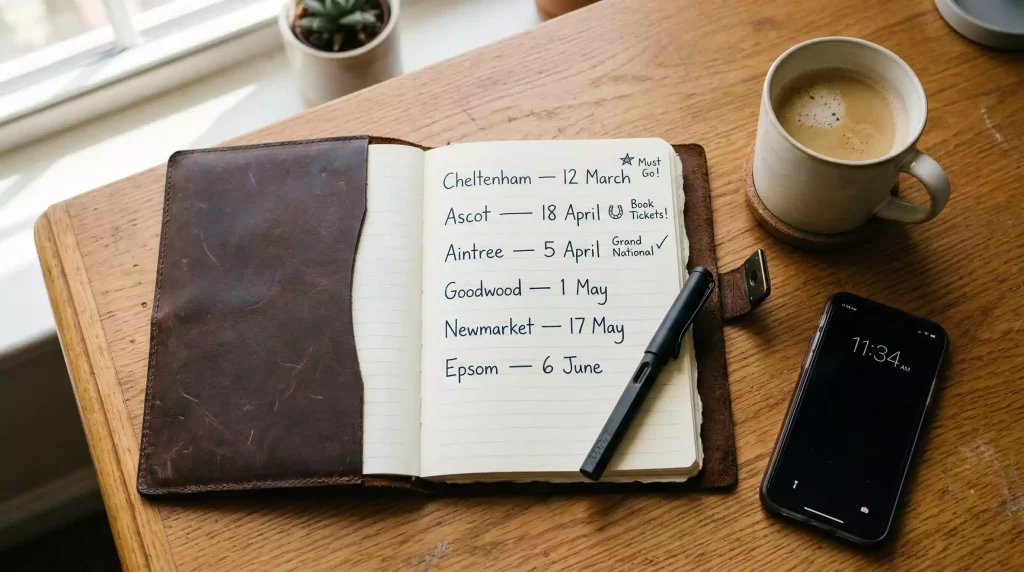
UK horse racing fixtures run every single day of the year except Christmas Day and Good Friday. In 2026, the BHA scheduled 1,460 fixture days — roughly four meetings on any given afternoon or evening — spread across 59 racecourses, two codes and three surface types. That is more racing than any other country in the world produces, and the fixture list is the skeleton on which every result, every racecard and every betting market hangs.
The BHA’s 2026 fixture list was published earlier than usual, giving trainers and owners more time to plan campaigns. It was also the second year of a two-year trial of structural changes designed to make British racing more competitive, more appealing to fans, and better timed for the betting market. Understanding UK horse racing fixtures is not just about knowing when the next race is — it is about understanding the system that determines what races exist in the first place.
Seasonal Breakdown
British racing operates on a dual-code calendar. National Hunt racing — steeplechases, hurdles and NH flat races — dominates the winter months, running from October through to late April. The Cheltenham Festival in March and the Grand National meeting in April form the climax of the jump season. Between May and September, jump fixtures are scarce, limited to a handful of summer meetings at courses like Market Rasen, Worcester and Newton Abbot.
Flat racing on turf runs from mid-April to early November. The season opens at Doncaster with the Lincoln Handicap, builds through the spring Classics at Newmarket and Epsom, peaks with Royal Ascot in June and Glorious Goodwood in July, and closes with Champions Day at Ascot in October. All-weather Flat racing continues year-round, filling the gaps and providing continuity during the winter months when turf racing is suspended.
The overlap between the two codes creates a compressed spring programme — March and April — where jump and Flat racing run simultaneously. This is the busiest period of the fixture calendar. Multiple meetings run every day, betting turnover peaks, and the results flow at their densest rate. For the bettor tracking form across both codes, spring is the most information-rich — and the most demanding — time of year.
The 1,460 fixture days in 2026 represented a reduction of eight from the 1,468 in 2026, reflecting a deliberate strategy to trim volume in favour of quality. Fewer fixtures, in theory, means fewer races chasing the same pool of horses, which means larger fields and more competitive results at the meetings that remain.
The Two-Year Fixture Trial
In January 2026, the BHA launched a two-year trial of significant fixture-list changes, running through to the end of 2026. The trial had three overarching objectives: create a more identifiable top end of the sport through Premier fixtures; grow the value of Sunday racing; and improve race competitiveness at all levels.
The protected Saturday window was one of the trial’s most visible measures. Between 2pm and 4pm on Saturdays, the number of simultaneous fixtures was capped to reduce race clashes. The impact was measurable: the proportion of Saturday afternoon races that clashed — defined as a British or Irish race running into a British race — fell from 8.3% to 5.7% by the end of October 2026. Fewer clashes mean better viewing for television audiences, a cleaner experience for streaming customers, and more orderly betting markets.
Sunday evening fixtures were piloted as a new slot, tested against the established midweek evening programme. The results were mixed: Sunday evening turnover averaged only 3.6% higher than midweek floodlit fixtures, falling short of the 15–20% target. The pilot revealed that simply moving a fixture to a different slot does not automatically attract more interest — the content of the card matters as much as the timing.
The 300-race reduction in programmed jump races was a bolder move. By scheduling fewer NH races, the BHA aimed to concentrate the existing horse population into fewer events, producing larger fields and more competitive outcomes. The data showed improvement: average field sizes at Core jump fixtures exceeded the three-year average during most months of 2026, though ground conditions — an unusually wet early season — complicated the picture.
Key Calendar Highlights
The British racing calendar revolves around a series of anchor events that attract the largest audiences, the best horses and the highest betting turnover.
The Cheltenham Festival in March is jump racing’s showpiece: four days, 28 races, and the highest concentration of Grade 1 contests in the sport. The Grand National meeting at Aintree follows in April, culminating in the world’s most famous steeplechase. Between them, these two events generate more column inches, more betting activity and more public attention than the rest of the NH season combined.
On the Flat, the Classics sequence begins with the 1,000 and 2,000 Guineas at Newmarket in May, continues through the Oaks and Derby at Epsom in June, and concludes with the St Leger at Doncaster in September. Royal Ascot in June is the five-day extravaganza that defines the Flat season’s middle act. Glorious Goodwood in late July and the Ebor meeting at York in August round out the summer programme. Champions Day at Ascot in mid-October serves as the Flat season’s formal finale.
Each of these events generates results that carry disproportionate weight in form study. A horse that won a Group 1 at Royal Ascot has demonstrated a level of ability that a Class 4 winner at a Monday afternoon meeting has not. The fixture calendar tells you which results to prioritise — and, just as importantly, which results to treat with caution because the field quality was weak.
Between the marquee events, the calendar is filled with mid-tier fixtures that serve as trials, stepping stones and preparatory races. The Betfair Hurdle at Newbury in February is a Cheltenham trial. The Dante Stakes at York in May is a Derby trial. Results from these trial races reshape ante-post markets for the main events, sometimes dramatically. A decisive trial winner can shorten from 16/1 to 6/1 for the target race overnight. A disappointing trial run can push a horse from 8/1 to 25/1 or out of the race entirely.
Where to Find the Latest Fixture List
The BHA publishes the full fixture list on its website, typically in the autumn for the following year. The list includes every scheduled meeting, the course, the code (Flat, NH, or mixed), and whether the fixture has Premier or Core designation. Changes during the season — abandonments due to weather, rescheduled meetings, additional fixtures — are published as amendments and reflected in real-time on Racing Post, At The Races and Timeform.
Individual racecourse websites publish their own fixture calendars, which include ticketing information, event details and promotional offers alongside the racing programme. For the bettor, the BHA list is the most reliable single source; for the racegoer, the course’s own page provides the practical detail. Either way, the fixture list is the foundation — the schedule that tells you when results will exist and where they will come from.