
Winning Distances in Horse Racing — Lengths, Necks and Noses
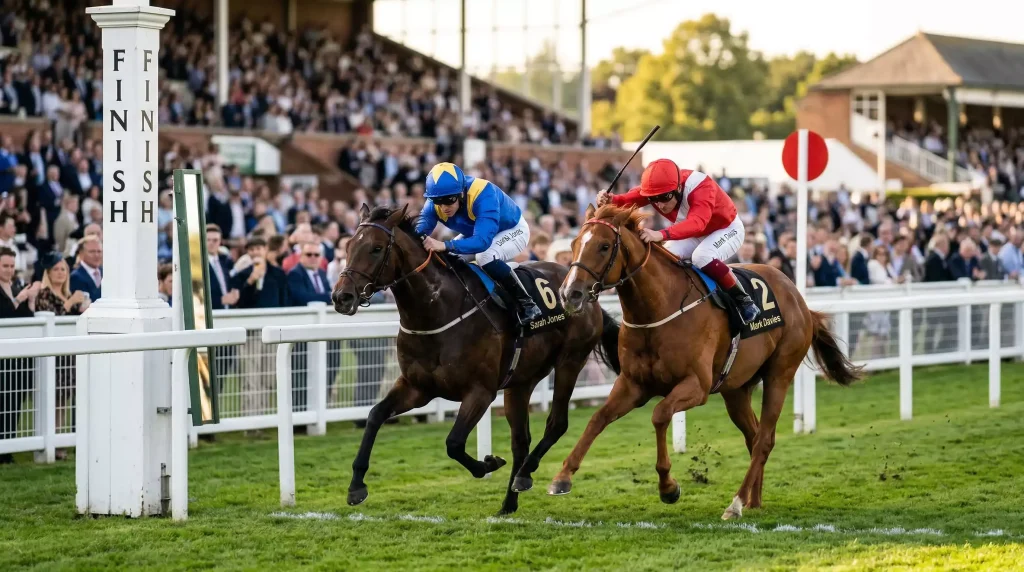
The gap between two horses on a racing result is never expressed in metres or seconds. It is measured in body parts and body lengths — a system that has governed British racing for centuries and still defines how we read form today. Winning distances in horse racing communicate something that a raw time cannot: how dominant a victory was, how close the finish, and whether a beaten horse was unlucky or simply not good enough. A horse that wins by eight lengths dominated. A horse that wins by a nose survived. Both won, but the distance tells you entirely different stories about what might happen next time.
Across roughly 10,000 races held in Britain each year — split approximately 65% Flat and 35% over jumps, according to BHA data — every single finishing gap is recorded using this system. It appears in every result, on every platform, and in every form guide. Understanding what the numbers mean, and more importantly what they imply, is one of the simplest ways to extract value from the results you already check.
The Unit System
The basic unit is the length. One length is the approximate distance from a horse’s nose to the root of its tail — roughly 2.4 metres, or about eight feet. When a result says a horse won by three lengths, the gap between the winner’s nose and the second horse’s nose at the line was approximately 7.2 metres. In a sport where races can be over two miles long, that sounds like nothing. In practice, three lengths is a comfortable margin that usually indicates clear superiority.
Below a length, the scale contracts into smaller units. A neck is the length of a horse’s neck — perhaps a third of a length, or about 0.8 metres. A head is shorter still, roughly the length from a horse’s ears to its nostrils. A short head is half of that. And a nose — the tightest margin possible without a dead heat — is exactly what it sounds like: the tip of one nostril in front of another. In time terms, a nose might represent one-hundredth of a second.
The full hierarchy runs as follows, from largest to smallest commonly recorded distance: distance (used when the gap is so large it is not worth measuring precisely, typically 30 lengths or more), then numerical lengths (1, 2, 3, and so on, with fractions like a half, three-quarters, and a quarter), then a neck, a head, a short head, and a nose.
Dead heats occur when two horses cannot be separated — their noses cross the line at precisely the same moment. Dead heats are rare but not unheard of, and they have specific implications for bet settlement: the stake is divided in half, and each half is settled at full odds. A dead heat for first is two winners, not zero.
You will also encounter combined distances in results. A result might read: “1st Horse A, 2nd Horse B (2 lengths), 3rd Horse C (neck).” This means Horse B finished two lengths behind Horse A, and Horse C finished a neck behind Horse B. The distances are cumulative only if you add them: Horse C was two lengths and a neck behind the winner. Some results display cumulative distances; others show only the gap between consecutive horses. Check which format the platform uses before drawing conclusions.
How Distances Are Judged
At every British racecourse, the official judge is positioned in a box directly above the finish line. For close finishes, a photo-finish camera captures the horses as they cross the line, producing a strip image that shows the precise order and the margin between them. The judge reviews this image before calling the result.
The technology has improved enormously. Modern photo-finish cameras operate at extremely high resolution, and the images are available to the judge within seconds. For wider margins — anything beyond a few lengths — the judge simply calls it by eye. For the tightest finishes, the photograph is essential, and you will see “photo” flashed on course screens while the judge deliberates.
According to the BHA, stewards at every racecourse have access to a minimum of four camera angles for reviewing races. As the BHA’s official guidance explains, a stewards’ enquiry panel is advised by the Stipendiary Steward, and the panel has available to it at least four camera angles of the race — a level of scrutiny that ensures both finishing positions and the manner of running are recorded with precision. These cameras are not used for distance measurement — that remains the judge’s role — but they provide the visual evidence if a stewards’ enquiry is called into the manner of a horse’s running. The cameras and the photo finish work in parallel: one determines where the horses finished, the other determines whether they competed fairly.
Distances are occasionally revised after the initial call. The judge may announce “half a length” immediately, then adjust to “three-quarters of a length” once the photograph has been studied. These adjustments are reflected in the full result but may not appear in the fast result, which is published before the photo has been fully examined.
Using Distances in Form Study
The distance a horse wins or loses by is one of the most underused tools in the punter’s kit. A horse that won by five lengths was clearly superior to the field on the day. A horse that was beaten a short head was essentially level with the winner and may well reverse the form next time with even a marginal improvement in fitness, ground conditions, or jockey tactics. The finishing position alone — first, second, third — does not convey this nuance. The distance does.
When studying form, look at the distances in the context of the race distance. A five-length winning margin in a five-furlong sprint is enormous — it represents a huge speed differential over a short trip. A five-length winning margin in a three-mile steeplechase is significant but more common, because stamina-sapping distances tend to produce larger gaps between horses. The same margin carries different weight depending on the race type.
Beaten distances are equally informative. A horse beaten 15 lengths in a Group 1 race may still be a very useful performer dropping back to Group 3 or listed company. A horse beaten a head in a Class 5 handicap was almost good enough to win a moderate race. Context, always context.
Improving distances are a strong positive signal. A horse that was beaten six lengths two runs ago, then three lengths last time, is closing the gap. If it is now dropping in class or getting a change of conditions, the trend points towards a win. Conversely, increasing beaten distances suggest a horse is going the wrong way — perhaps losing fitness, carrying more weight, or being asked to race beyond its optimal trip.
Distances in Jump vs Flat Racing
Jump racing tends to produce larger winning distances than Flat racing, and this is not a coincidence. Jump races are longer — the shortest is two miles, the longest over four — and the presence of obstacles adds a stamina element that amplifies the gaps between horses. A three-length winning margin over Flat six furlongs is a demolition. A three-length margin over hurdles at two miles four furlongs is solid but unremarkable.
Jumps results also more frequently include non-finishing codes (P, F, U) that interrupt the distance chain. If only eight of twelve runners completed a three-mile chase, the distances shown in the result reflect only those eight, and the gaps can be deceptive. The second horse might have finished ten lengths behind the winner, but the runner that pulled up at the third-last might have been the biggest danger. Distances in jumps results need to be read alongside the full finishing list, not in isolation.
On the Flat, especially in sprints and mile races, winning margins are typically tighter. Dead heats and short-head victories are more common. The form student analysing Flat results must pay close attention to tiny margins because the competitive hierarchy is compressed. A horse beaten a length in a six-furlong sprint at Ascot is still a very capable animal. The same beaten margin in a two-mile hurdle at Plumpton tells you less.